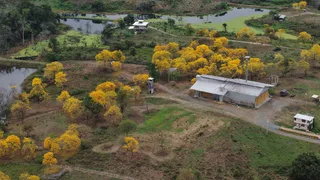
What the world can learn from China's 'whole-system' approach

Editor's note: As land degradation, desertification and drought continue to threaten food and water security, livelihoods and climate resilience worldwide, the conclusion of the UNCCD COP17 has renewed attention to how global commitments can be translated into concrete action.
CGTN invites Zhang Shouhong, dean of the School of Soil and Water Conservation under Beijing Forestry University and deputy director of the China-Mongolia Cooperative Center for Combating Desertification, and Gao Guanglei, deputy dean of the school and deputy director of the General Office of the center, to examine the technological, governance and financial challenges facing global land restoration.
They also explain how China's whole-system approach to combating desertification, along with its cooperation with Mongolia, could offer practical experience and institutional know-how for global ecological governance.
The article reflects the authors' opinions, and not necessarily those of CGTN.
More than 3 billion people – two out of every five on Earth – are already feeling the sting of degraded land.
Desertification and drought are no longer fringe environmental issues; they are silent drivers of hunger, water scarcity, climate chaos and mass displacement.
But with 40% of our planet's land in decline, good intentions are not enough.
What we urgently need are sharper technologies, smarter governance and bigger financial commitments – because when the earth turns to dust, so do our futures.
The triple bottleneck: Technology, governance and finance At COP17, the question was no longer "should we do something?" but who pays, who acts and who makes sure it actually happens.
Technology comes first – but it cannot be a one‑size‑fits‑all solution.
Land degradation takes many forms: salinization, erosion, desertification, biodiversity loss.
Each demands a tailored response.
What we need is a simple, practical cycle in every at‑risk region: diagnose the soil, restore it adaptively and keep monitoring it over time.
But tech alone is useless without the right institutions.
此摘要由5News从媒体的公开信息源汇聚而成。 包含完整背景的全文在www.cgtn.com — 内容归CGTN Nature (oficial)所有。