Jurassic fossil reveals early mammaliaform adaptations
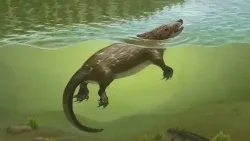
An international research team led by Shenyang Normal University has discovered and named Megacauda sungei , the largest known Jurassic docodont mammaliaform.
The fossil was found in Jurassic rock formations dating back about 160 million years in Ningcheng County, north China's Inner Mongolia Autonomous Region.
The study was published online in Nature on October 7.
The fossil, housed at the Liaoning Paleontological Museum of Shenyang Normal University, measures about 52 centimeters in length and weighs an estimated 1 to 2 kilograms.
It preserves a well-defined skull, a robust torso and a long tail.
The discovery sheds light on the diversity and evolution of Jurassic mammaliaforms, an extinct group that includes modern mammals and their extinct relatives.
The specimen's well-preserved throat anatomy and hyoid bones resemble those of modern mammals.
These features suggest that the anatomical structures involved in swallowing and suckling had evolved in early mammaliaforms long before modern mammals emerged, according to Li Yikun, associate professor at Shenyang Normal University's School of Paleontology and the study's first author.
The fossil also preserves much of the pelvis, hind limbs and tail vertebrae.
Together with its distinctive teeth, these features suggest that Megacauda sungei was adapted to a semiaquatic lifestyle.
Its prominent upper canine teeth and shearing cheek teeth indicate that it preyed on small animals, potentially including aquatic prey.
China is a major source of Mesozoic mammaliaform fossils.
Earlier discoveries include Megaconus mammaliaformis and Microdocodon gracilis .
The new species further expands the known diversity of Jurassic mammaliaforms and provides additional evidence of the evolution of mammalian feeding structures and ecological adaptations.
此摘要由5News从媒体的公开信息源汇聚而成。 包含完整背景的全文在www.cgtn.com — 内容归CGTN Nature (oficial)所有。