Is global warming to blame for the mudslide along China-Nepal border?
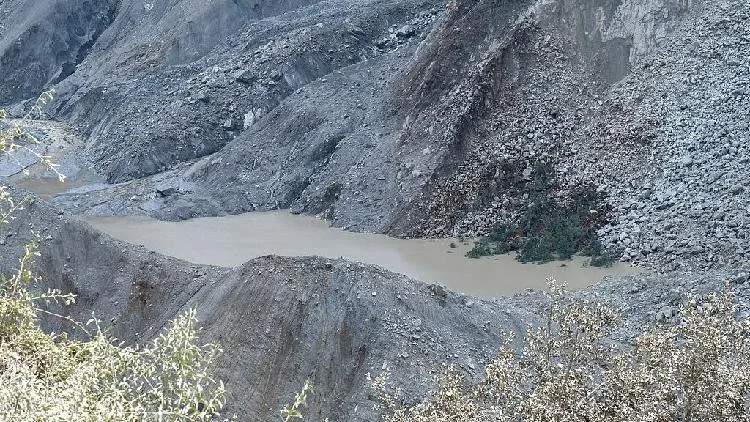
Experts said global warming was a major factor behind the catastrophic mudslide on August 26, caused by a massive glacier collapse in Nepal.
Driven by global warming, glaciers around the world, including those on China's Qinghai-Xizang Plateau, are shrinking at an accelerating pace each year, increasing the risk of such geological hazards.
Glaciers shrinking rapidly Experts said China's long-term glacier inventory work has provided important support for the glacier monitoring and early-warning systems in the region.
China has completed three nationwide glacier inventories over the past 60 years.
Data show that glacier coverage on the Qinghai-Xizang Plateau has declined significantly, from about 61,000 square kilometers recorded in the first inventory to 44,000 square kilometers in the second, and the latest inventory shows the glacier area has fallen to about 39,000 square kilometers.
Kang Shichang, director general of the Institute of Mountain Hazards and Environment (IMHE) under the Chinese Academy of Sciences, said glaciers on the plateau have retreated rapidly over the past 60 years.
Glacier area on the Qinghai-Xizang Plateau has shrunk by about 24% over the past six decades, nearly a quarter, Kang said, adding that the most severe retreat has occurred in the southern part of the plateau, including the Gangdise Mountains, Nyenchen Tanglha Mountains and the Himalayas, where glacier area has decreased by about 40%.
Kang attributed this mainly to global warming, noting that glaciers worldwide are declining.
Expanding glacial lakes One direct consequence of glacier retreat is the significant expansion of glacial lakes.
Monitoring data show that more than 14,000 glacial lakes now cover more than 1,100 square kilometers across the Qinghai-Xizang Plateau.
Glacial lakes have generally expanded rapidly over the past decades, especially in the Himalayan region along China's southern border, said Nie Yong, a researcher at the IMHE.
"Glacial lakes in this area are growing by about 1% each year." Chain disasters Experts said glacier-related disasters are often interconnected rather than isolated events.
Glacial lake outbursts, ice avalanches and ice-rock avalanches can trigger a chain of cascading hazards.
In the Himalayas, more than 100 glacial lakes are currently considered high risk.
此摘要由5News从媒体的公开信息源汇聚而成。 包含完整背景的全文在www.cgtn.com — 内容归CGTN Nature (oficial)所有。