Expert: Nepal's ice avalanche triggers deadly Gyirong mudslide
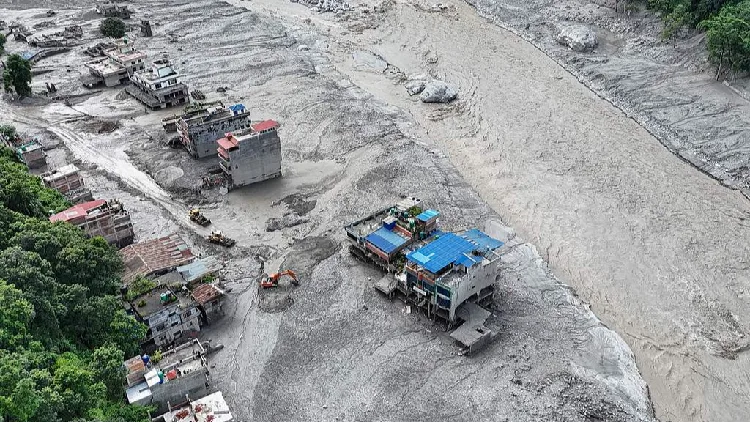
A high-altitude ice avalanche in Nepal triggered a chain of events that evolved into a devastating mudslide and struck Gyirong Port in southwest China's Xizang Autonomous Region, according to China's Ministry of Natural Resources.
A powerful mudslide struck Gyirong County in Xizang on Wednesday.
The Ministry of Natural Resources activated a Level-II geological disaster emergency response at 3 p.m. the same day and dispatched a working group to the site to assist with emergency rescue efforts and the prevention of further geological disasters.
The high-altitude ice avalanche upstream in Nepal led to a debris flow that later developed into a mudslide, according to the ministry.
Guo Zhaocheng, a senior engineer at the China Aero Geophysical Survey and Remote Sensing Center for Natural Resources, said high-resolution remote sensing images and expert analysis show that the high-altitude ice avalanche occurred on the upper reaches of Cuojian, a tributary of the Donglin Zangbo River in Nepal.
The collapsing ice scraped up moraine deposits along the valley, forming a high-speed debris flow that continued downstream before evolving into a mudslide, which surged toward Gyirong Port, causing major casualties.
Experts believe the ice avalanche originated in a glacial area at an elevation of 5,200 to 5,500 meters.
Falling from such a high altitude, the massive collapse released enormous potential energy, forming a high-speed debris flow that eventually evolved into a mudslide.
Glaciers are constantly moving, carrying rocks from high mountain areas downstream.
But in areas with particularly steep terrain or heavily fractured geological structures, the glacier and surrounding rock can suddenly break apart and collapse.
According to records, the ice avalanche took about seven minutes to reach Gyirong Port, traveling roughly 20 kilometers in that time – an extremely high speed.
The sudden ice avalanche also triggered secondary hazards and created multiple risks.
But what exactly is an ice-avalanche debris flow, how destructive can it be, and what dangers could a resulting barrier lake pose? Guo explained that glaciers moving gradually and regularly do not normally cause disasters.
However, when a glacier suddenly undergoes violent movement, rapidly surges forward or collapses from a high altitude, it can mobilize accumulated glacial debris.
此摘要由5News从媒体的公开信息源汇聚而成。 包含完整背景的全文在www.cgtn.com — 内容归CGTN Nature (oficial)所有。