81 years after surrender: Japan downplays wartime aggression
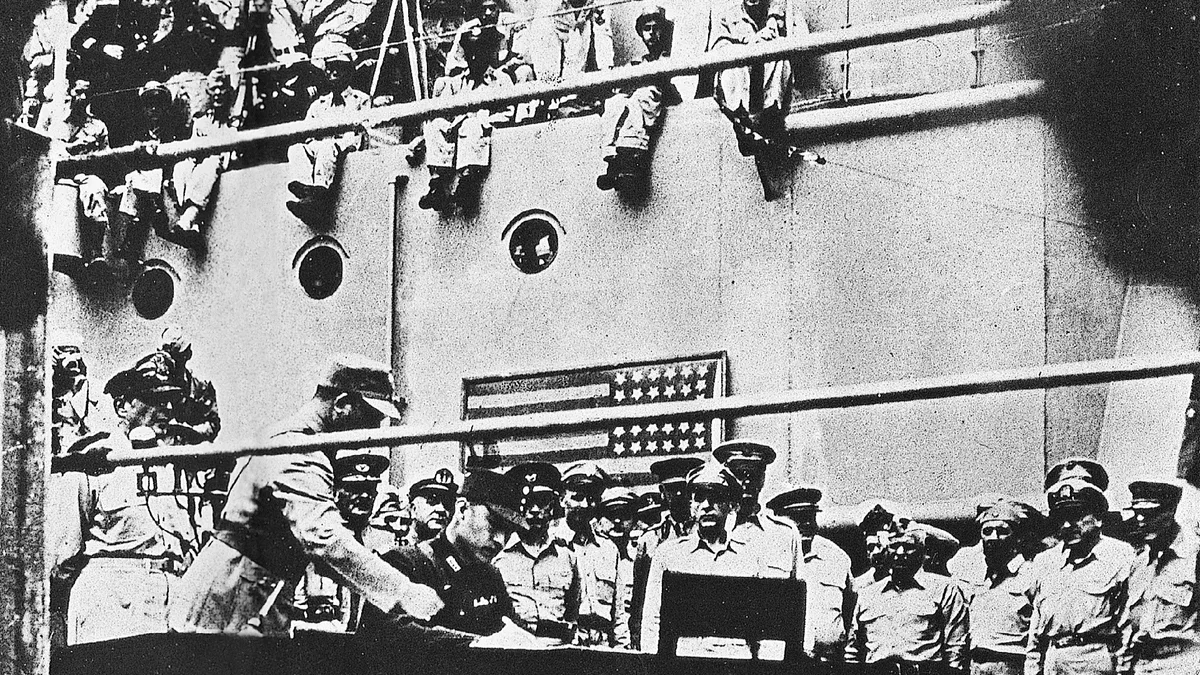
Eighty-one years ago today, Japanese Emperor Hirohito announced Japan's acceptance of the Potsdam Declaration's terms and its unconditional surrender, paving the way for the formal end of World War II in September.
During Japan's invasion of China, more than 35 million Chinese military personnel and civilians were killed or injured, according to the National Archives Administration of China.
Yet 81 years after the guns fell silent, some in Japan ignore, deny or even glorify its history of aggression.
Lyu Yaodong, a researcher at the Institute of Japanese Studies, Chinese Academy of Social Sciences, said that although the war happened in the past, historical issues continue to shape the present.
Japan's historical revisionism has not only fueled tensions with neighboring Asian countries, he said, but also affected regional politics, security and economic cooperation, posing a threat to peace and stability in the Asia-Pacific.
Historical revisionism continues to fuel tensions and undermine regional trust Japan's attempts to revise textbooks and downplay or distort its wartime aggression – including the "comfort women" system, biological warfare and human experimentation – have drawn strong opposition from countries that suffered under Japanese invasion.
Between 1931 and 1945, the Japanese military forcibly recruited over 200,000 Chinese women into sexual slavery, according to Shanghai Normal University's Research Center for Comfort Women.
In 2025, several UN special procedures mandate holders raised concerns over ultranationalist groups lobbying to remove references to Japan's wartime "comfort women" system from textbooks.
In their letter, they noted that Japan's Ministry of Education, Culture, Sports, Science and Technology (MEXT) in 2021 approved five publishers' requests to delete or revise terms such as "military-accompanying comfort women" and "forceful taking away" while rejecting the term "military sexual slavery." Japan has also sought to gloss over its history of biological warfare.
Japanese historian Masataka Mori said Unit 731 is scarcely mentioned in Japanese textbooks.
"Whether young or old, most Japanese people know the name Unit 731, but they don't know what crimes it actually committed," he said.
Testimony from Kurumizawa Masakuni, a former member of Japan's Unit 731, has revealed its atrocities.
Masakuni said the Japanese military established a biological warfare base in Harbin, Heilongjiang Province in northeast China, where at least 3,000 people were used as human experimental subjects between 1940 and 1945.
Victims were subjected to experiments involving deadly pathogens such as plague and cholera, as well as frostbite and poison gas exposure.
此摘要由5News从媒体的公开信息源汇聚而成。 包含完整背景的全文在www.cgtn.com — 内容归CGTN World (oficial)所有。