Expanding service circle: China's space robot takes on versatile roles
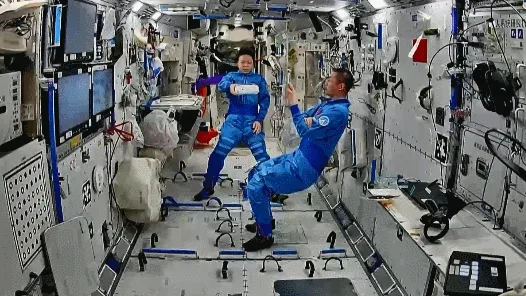
The first intelligent flying robot aboard China's space station, Xiaohang, is becoming an increasingly capable assistant for astronauts, supporting scientific experiments and daily operations in orbit.
Xiaohang made its debut in the space station on January 1, 2025.
Since then, it has worked with four crews, conducting multiple rounds of in-orbit verification and continuously improving through data collection and experiments.
By interacting with Xiaohang and human-machine collaborative interaction experimental software, astronauts have carried out research on human-machine spatial relationships, robot behavior representation and multimodal interaction technologies, helping enhance mission efficiency.
The robot can also carry out cabin inspections, monitor equipment and take photos.
Through voice commands, astronauts can ask the robot to record key information such as experiment procedures and equipment conditions, making it an important assistant in space.
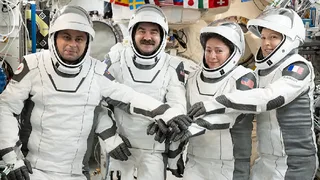
In 2025, Xiaohang first partnered with the Shenzhou-19 crew, conducting experiments including multimodal interaction technology research, further enhancing coordination between astronauts and the robot.
The Shenzhou-20 crew continued working with Xiaohang to explore methods for more efficient human-machine collaboration through experiments on spatial relationships.
In 2026, the robot again joined forces with the Shenzhou-21 crew, conducting experiments on human-machine spatial relationships and multimodal interaction technologies.
More recently, the Shenzhou-23 crew carried out touch-based interaction tests with the robot, collecting data to optimize future in-orbit robot motion planning.
Each round of experiments has helped Xiaohang become more intelligent and better understand astronauts' needs, evolving into a smarter and more reliable space companion.
此摘要由5News从媒体的公开信息源汇聚而成。 包含完整背景的全文在www.cgtn.com — 内容归CGTN Tech & Sci (oficial)所有。