The Milky Way swallowed a smaller galaxy about 11.8 billion years ago
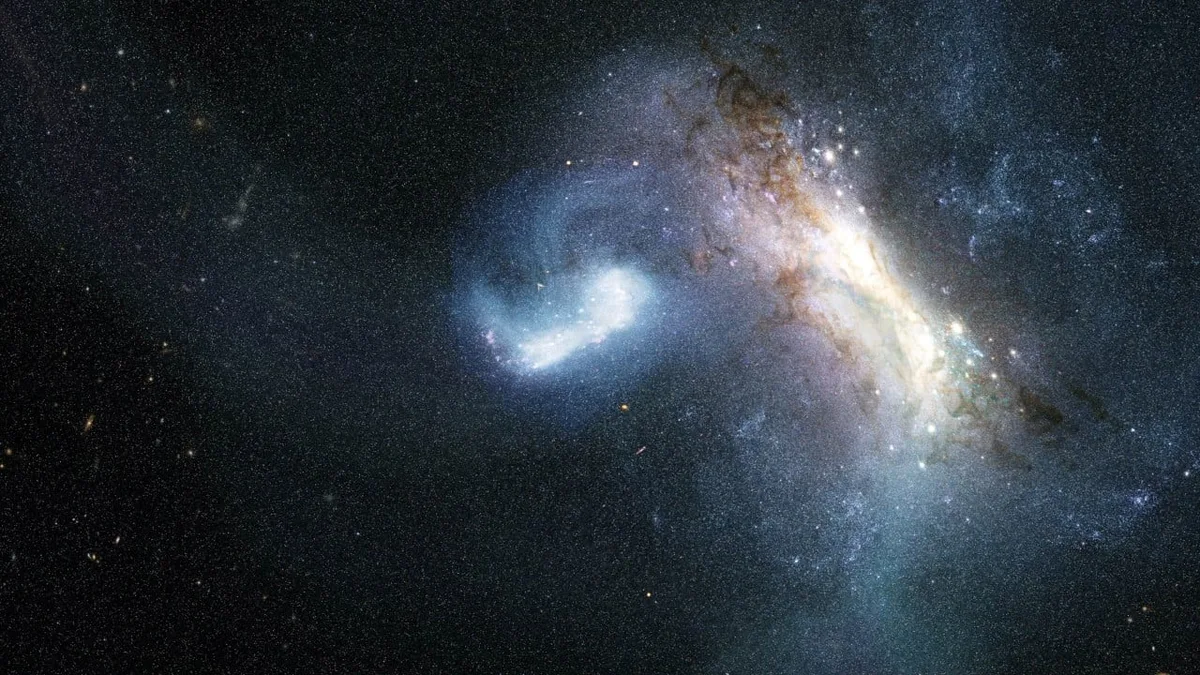
Scientists say the event shows Milky Way grew not only by forming its own stars but also by merging with smaller galaxies caught in its gravitational pull
The Milky Way, a large and spiral-shaped galaxy that is home to hundreds of billions of stars including our sun, has taken a long and complicated path to achieve its current dimensions, as illustrated by new research documenting a milestone event early in its history.
Scientists observing clusters of stars congregated near the Milky Way’s centre have discovered evidence that our galaxy swallowed a smaller galaxy roughly 11.8 billion years ago, when the universe was less than 15 per cent of its current age. The event represents the Milky Way’s earliest-known galactic merger and shows how it grew not only by forming its own stars but also by merging with smaller galaxies caught in its gravitational pull.
The smaller galaxy is classified as a dwarf galaxy, differentiating it from larger ones like the Milky Way. The researchers estimate that it contained stars with a mass equivalent to 500 million times that of the sun at the time of the merger, about a quarter the size of what the Milky Way was at the time.
The researchers used the orbiting Hubble and Gaia telescopes to study stellar clusters, each containing hundreds of thousands of stars, inhabiting a region spanning the Milky Way’s innermost 20,000 light-years, gauging their age, chemical composition and trajectory. A light-year is the distance light travels in a year, 9.5 trillion km (5.9 trillion miles).
These stars became part of the Milky Way after a galactic merger that occurred about 2 billion years after the Big Bang event that initiated the universe, they said. The dwarf galaxy where they originated was given the name Low-energy-Kraken-Heracles, or LKH, in recognition of three earlier studies that examined the possibility of such a primordial merger.
“The key finding of our research is the unambiguous discovery of the first merger event experienced by our galaxy in its infancy,” said astrophysicist Davide Massari of the National Institute for Astrophysics (INAF) in Bologna, Italy, lead author of the study published in the journal Nature Astronomy.
Whether the Milky Way’s early growth was fuelled by home-grown star formation or a galactic merger has been a matter of debate, according to Massari. The new study indicates that the merger infused the Milky Way early in its history with a large volume of stars and interstellar gas that feeds star formation, as well as the mysterious substance called dark matter.
此摘要由5News从媒体的公开信息源汇聚而成。 包含完整背景的全文在www.scmp.com — 内容归South China Morning Post - World所有。