One bad apple and netizen-researcher collab leads to a super mushroom
How extraordinary a scientific miracle can a discarded rotten apple create? Two years ago, a wild fungus accidentally discovered by a netizen in east China's Zhejiang Province traveled over 2,000 kilometers to a research laboratory.
After eight generations of selective breeding and crossbreeding with space-bred fungal strains, the eighth-generation "king fruit mushroom" has finally debuted.
It has transformed from an accidental fungal growth into a premium table delicacy, presenting a heartwarming story of public-participated scientific research.
The story dates back to the rain season in southern China in 2024.
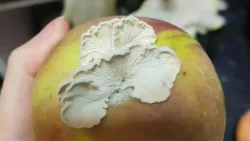
Deng Lixing, a resident in Deqing, Zhejiang, spotted a uniquely shaped white fungus growing on a rotten apple at home.
She snapped a casual photo and posted it on social media.
Thousands of kilometers away, Xu Rongju, a PhD candidate at the Kunming Institute of Botany, Chinese Academy of Sciences, came across the post.
He instantly identified the organism as Schizophyllum commune , an edible and medicinal fungus locally known as "white ginseng mushroom" in Yunnan.
Notably, its growth on an apple is an extremely rare phenomenon worldwide.
Normally, Schizophyllum commune feeds on lignin.
To survive on an apple, one male and one female spore must land precisely on the apple's core or stalk, complete successful mating and eventually germinate into a fruiting body – a chance as slim as winning the lottery.
Driven by acute scientific intuition, Xu immediately contacted the netizen to request the sample.
Deng generously delivered the apple via cold-chain logistics free of charge, and the one-of-a-kind sample arrived safely at the Kunming laboratory after a cross-country journey.
After on-site inspection and analysis, the research team confirmed the rare wild strain.
此摘要由5News从媒体的公开信息源汇聚而成。 包含完整背景的全文在www.cgtn.com — 内容归CGTN China (oficial)所有。