The world needs BRICS to be the adult in the room
Editor's note: Ankit Prasad is a CGTN Biz commentator.
The article reflects the author's views and not necessarily those of CGTN.
For several years since its first official leaders' meeting, held in Yekaterinburg, Russia, in 2009, BRICS (initially just BRIC) was regarded in terms of other groupings, or as a counter to some prevailing bloc or architecture.
In fact, the joint declaration of the first BRIC summit in Yekaterinburg, Russia, began by upholding the central role of the G20 in dealing with the 2008 financial crisis, which had at that time cast a long shadow over global affairs.
The same declaration also put its faith in UN bodies to successfully tackle matters of geo-economics, besides supporting the multilateral trading system and opposing protectionism.
In subsequent years, as BRICS expanded, so did the perception around it.
Over the course of a decade, it went from being a quaint coming together of developing nations named after a now-famous Goldman Sachs confabulation—to being insidiously cast as a challenge to the Western-dominated world order, or as the emerging markets' answer to the G7, or some such...
Now, on the eve of its 18th Summit, the characterization of BRICS is changing again.
To put it simply, the BRICS of 2026 needn't be regarded as a counterweight to anyone.
In practical terms, when you comprise 3.85 billion people or 46.3% of the world's population, 44 million square km or 29.5% of the world's land area, and account for 40% of the global GDP (in PPP terms), 26% of global trade and over half of global economic growth—that is scale that allows you to decide what you represent and what your agenda is.
The 2025 BRICS summit in Rio de Janeiro, Brazil, witnessed ten nations joining as BRICS partner countries—seen as the grouping increasingly coming to represent the aspirations of the Global South.
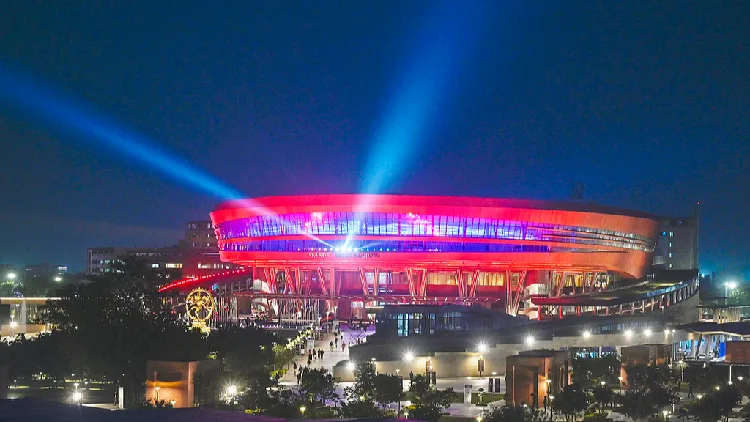
Now, on the eve of the 18th annual summit in New Delhi, India; at a time when long-running global systems and architectures are fraying and the rule-based order is giving way to unilateralism and belligerence, BRICS appears set to complete its role-reversal.
What began as an also-ran on the fringes has now become the right-thinking mainstream lynchpin of normalcy.
And normalcy has been in increasingly short supply.
此摘要由5News从媒体的公开信息源汇聚而成。 包含完整背景的全文在www.cgtn.com — 内容归CGTN Business (oficial)所有。