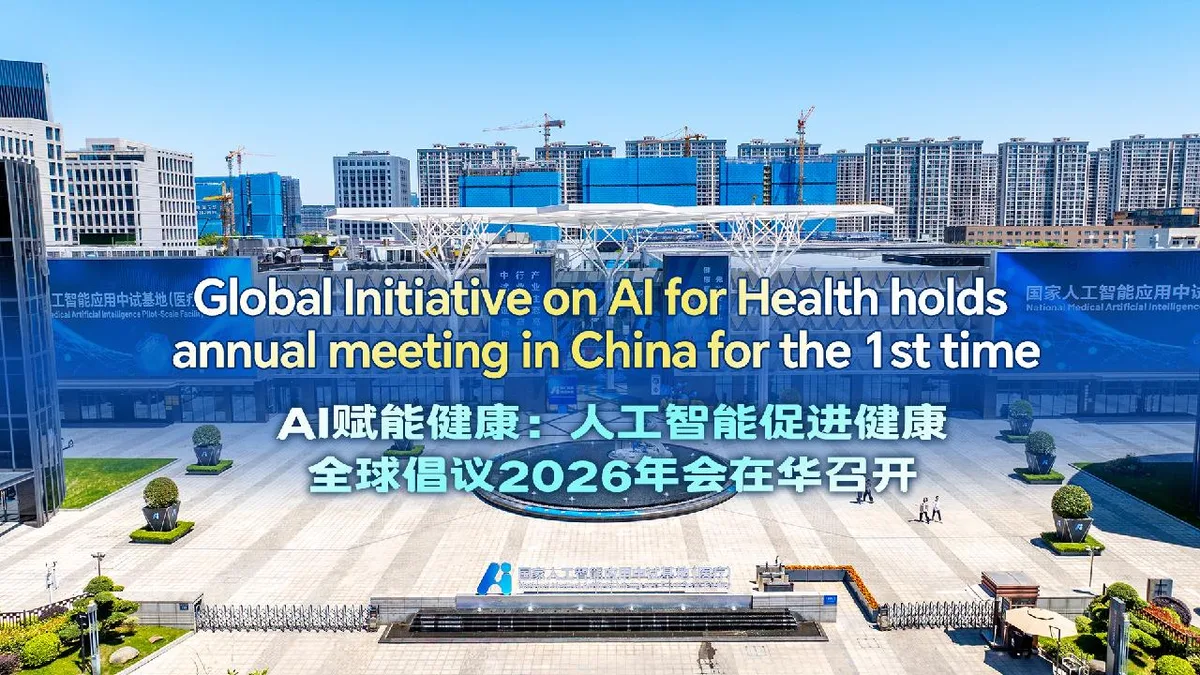
The GI-AI4H holds annual meeting in China
High-precision image interpretation, multi-disease screening, disease prediction, and rapid tracking of the latest global drugs and medical devices; these are just a few of the ways AI is rapidly transforming healthcare delivery.
The Global Initiative on AI for Health (GI-AI4H) held its annual meeting in China for the first time.
The initiative was launched jointly by the World Health Organization (WHO), the International Telecommunication Union (ITU), and the World Intellectual Property Organization (WIPO).
It aims to advance the use of AI in achieving health-related Sustainable Development Goals.
In Hangzhou, policymakers, health experts and technology leaders from more than 60 countries and regions are looking at how to turn AI's potential into solutions that can be scaled up and shared.
"Digital health and AI are not just about technology; they are also about people," said Alain Labrique, director of the Department of Data, Digital Health, Analytics and AI at the World Health Organization.
Dr.
Labrique added that one of the areas in which China has a lot to offer is capacity building, helping countries learn how to build the foundations so that when countries deploy AI or digital health solutions, they are sustainable.
China's AI pilot-testing bases show what works: faster and more accurate diagnosis, lower costs and smarter resource allocation.
You Mao, deputy director of China National Health Development Research Center, said, "AI isn't just about replacing doctors – it helps them do more and makes limited high-quality care go further.
The real question isn't 'What AI can we use?' It's 'What health problem do we most need to solve?' The world has to tackle the opportunities and challenges of AI and digital health together.
But every country needs to find its own path, based on its own health system and real needs." This year's annual meeting of the Global Initiative on AI for Health was locally organized by China National Health Development Research Center (CNHDRC), the China Academy of Information and Communications Technology (CAICT), and the China Health Economics Association (CHEA).
The initiative focuses on three pillars: enabling AI through standards and governance, facilitating collaboration and investment, and implementing solutions that can translate technological advances into tangible health interventions.
Driven by strategic policy initiatives like the "Healthy China 2030" plan and a rapidly expanding digital infrastructure, China's medical AI market is growing fast, offering practical lessons for low- and middle-income countries and becoming a shared opportunity for global development.
此摘要由5News从媒体的公开信息源汇聚而成。 包含完整背景的全文在www.cgtn.com — 内容归CGTN China (oficial)所有。