BRICS is putting capital behind climate action
Editor's note: Lu Jiajun is a researcher at the Academy of Financial Research and an assistant professor at Zhejiang University International Business School.
Zhu Yueteng is a researcher at the Academy of Financial Research and an assistant professor at School of Economics at Zhejiang University.
The article reflects the authors' opinions and not necessarily the views of CGTN.
Against the backdrop of the 2026 BRICS Summit's relatively low-key outcomes in New Delhi, one of the more consequential developments was China's call to reform the international financial architecture and give developing countries a greater voice.
The most tangible expression of that reform is green finance, which was a central focus of the summit rather than a side issue.
It sits at the heart of the "sustainability" pillar that India, as this year's chair, placed alongside resilience, innovation and cooperation.
The New Delhi Declaration called on developed countries to provide "additional, adequate, predictable, accessible" financial resources, while flagging the debt burdens that already constrain climate and development investment across the developing world.
It paired that with a call for coordinated action on debt sustainability and fiscal space, acknowledging that climate finance cannot be disentangled from the broader reform of an international financial system weighted against borrowers.
The diagnosis is familiar, and it is getting worse rather than better: The rich world's promise of $100 billion a year in climate finance, first made at Copenhagen in 2009, was not met until 2022, and roughly 70% of what eventually flowed arrived as loans, much of it non-concessional, adding to the very debt the declaration now names.
At COP29 in Baku, the replacement target, a floor of $300 billion a year by 2035 with an aspirational $1.3 trillion from all sources, was dismissed by India's negotiator as "a paltry sum." The skepticism is justified: developing countries' needs are estimated at $5.1 trillion to $6.8 trillion by 2030, while adaptation finance, which they have long prioritized, mobilized only about $28 billion in 2022 against an estimated need of $215 billion to $387 billion a year.
This is the gap a bloc of 11 members, more than 45% of the world's population and close to 37% of global GDP, is now signaling it will no longer simply wait for the incumbent system to close.
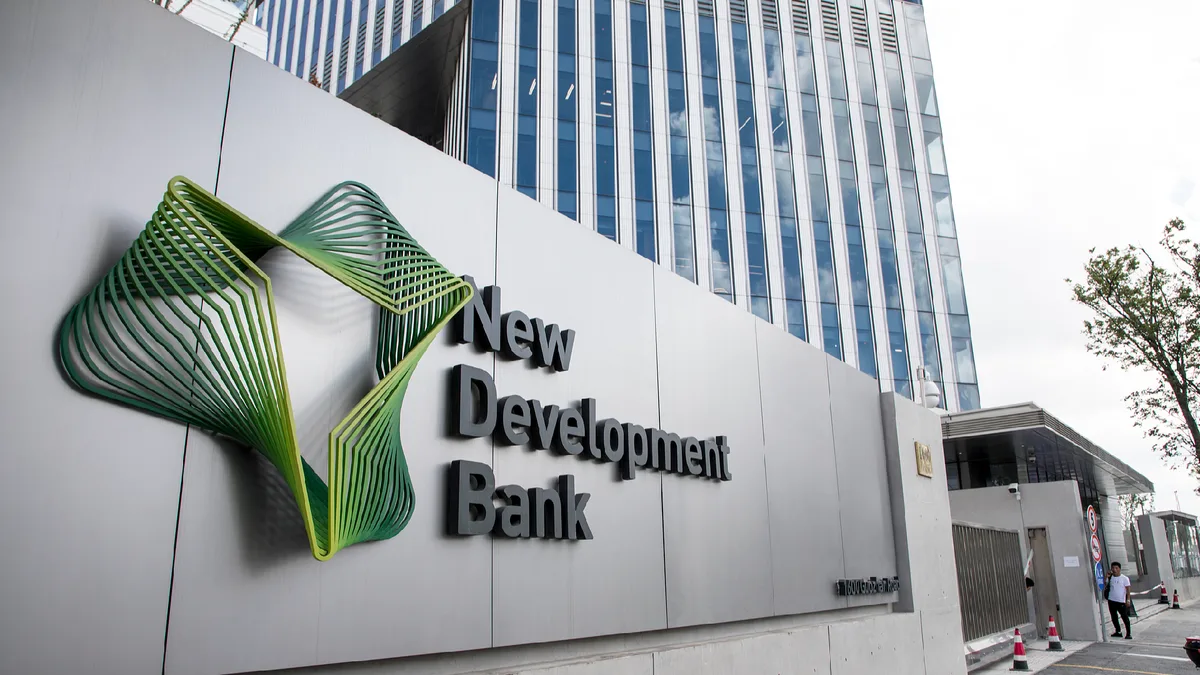
A bank, not a lecture The instrument is the New Development Bank, the BRICS-backed lender founded in 2015 that is quietly becoming an alternative source of finance for clean-energy and digital projects.
By mid-2026 it had approved 141 projects worth about $44 billion, and climate finance reached a record 57.1% of its 2025 approvals, well above the 40% it had targeted.
此摘要由5News从媒体的公开信息源汇聚而成。 包含完整背景的全文在www.cgtn.com — 内容归CGTN Business (oficial)所有。