China's people-centered cities: How Shanghai, Jiangsu put people first
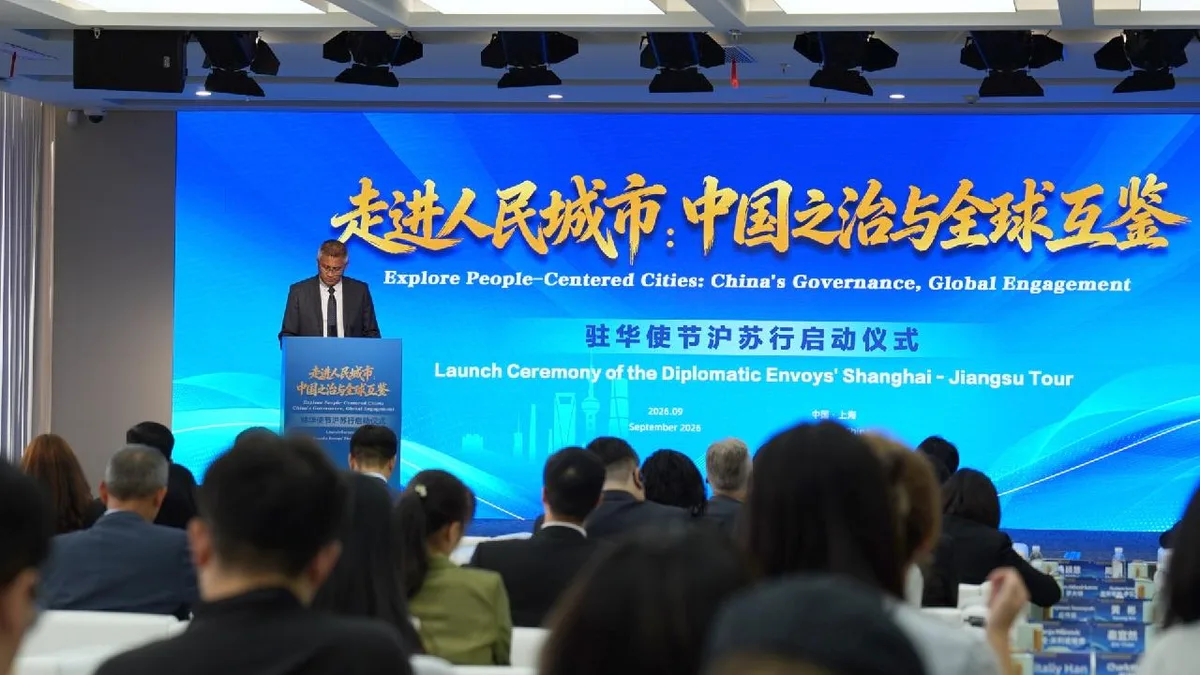
What does a people-centered city look like? That was the question explored by 30 diplomats from 20 countries during a visit to Shanghai and Jiangsu, as part of the event "People-Centered Cities: China's Governance, Global Engagement," hosted by China's Ministry of Foreign Affairs from September 7 to 11.
The idea of putting people at the center of urban development has been repeatedly emphasized in China, including the principle that "cities should be built by the people and for the people," put forward by Chinese President Xi Jinping, also General Secretary of the Communist Party of China Central Committee.
In Shanghai and Jiangsu, the answer can be found in communities, institutions and cities being built for the future.
Where people have a voice Located in Shanghai's Hongqiao Subdistrict, the Gubei Civic Center brings together public services, daily-life support, cultural exchange and community governance.
Since 2016, it has also served as a grassroots legislative contact point of the Standing Committee of the Shanghai Municipal People's Congress, giving residents a direct avenue to participate in legislative consultation.
The impact can be seen in the numbers.
At the broader Hongqiao Subdistrict legislative contact point, established in 2015, views have been sought on 125 draft laws, with 496 suggestions incorporated into legislation.
From voices to decisions "Over the years, as a deputy to the Shanghai Municipal People's Congress, I have always reminded myself to pay attention to those whose voices are often unheard," said Hu Xiaoli, a deputy to the Shanghai Municipal People's Congress.
By sharing her experience of working to improve the quality of life for Shanghai residents, including the elderly, Hu showed how listening to people's concerns can translate into practical efforts to address their needs.
Beyond the community level, the Shanghai Municipal People's Congress provides an institutional channel for bringing people's voices into the decision-making process.
As a local organ of state power, it exercises, in accordance with the law, powers including local legislation, supervision and decision-making on major matters, as well as election, appointment and dismissal.
Together, these mechanisms help connect public participation with legislation, decision-making and oversight – a key part of what China describes as whole-process people's democracy.
Putting people at the heart of development Putting people at the center is not only about how decisions are made.
It is also about what those decisions ultimately create – the places where people live, work and build their futures.
此摘要由5News从媒体的公开信息源汇聚而成。 包含完整背景的全文在www.cgtn.com — 内容归CGTN Politics (oficial)所有。