Q&A: What does the opening of the Pinglu Canal mean for China?
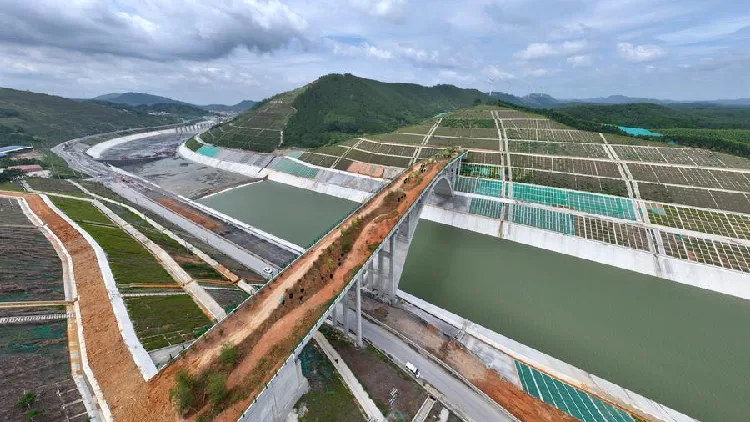
A new waterway in south China's Guangxi Zhuang Autonomous Region is opening up a faster route to the sea for the country's southwest.
The 134.2-kilometer Pinglu Canal, stretching from the mouth of the Pingtang River in Hengzhou, Nanning, to the Beibu Gulf, officially opened to navigation on September 16 after four years of construction.
The project, designed to accommodate vessels of up to 5,000 tonnes, involved a total investment of 72.7 billion yuan (about $10.8 billion).
For Guangxi, the canal is a historic breakthrough.
Despite its coastal location, the region has long lacked a direct inland waterway linking its river network to the sea.
The new route connects Nanning directly with the Beibu Gulf, cutting the shipping distance to the sea by more than 560 kilometers and offering a more efficient, potentially less costly way to move goods from Guangxi and the wider southwestern region to global markets.
So what does the Pinglu Canal mean for China's broader development strategy? CGTN spoke with Cui Fan, professor at the School of International Trade and Economics at the University of International Business and Economics, to explore the canal's national significance and potential impact.
His responses have been edited for brevity and clarity.
1.
CGTN: What does the Pinglu Canal mean for China’s broader development strategy? Cui Fan: China is both a major maritime shipping power and a major inland waterway shipping power.
Its annual inland waterway freight volume has consistently ranked first in the world, at more than eight times that of the United States and roughly 10 times that of the European Union.
China's Yangtze River and Pearl River systems are the world's two largest inland waterway networks by freight volume.
To further leverage inland shipping, China has developed a national plan for a high-grade waterway network known as the "four vertical, four horizontal and two networks" layout.
The four horizontal waterways are the Yangtze River, Pearl River, Huai River and Heilongjiang River.
此摘要由5News从媒体的公开信息源汇聚而成。 包含完整背景的全文在www.cgtn.com — 内容归CGTN Politics (oficial)所有。