Expert: Mudslide triggered by climate-driven glacier collapse in Nepal
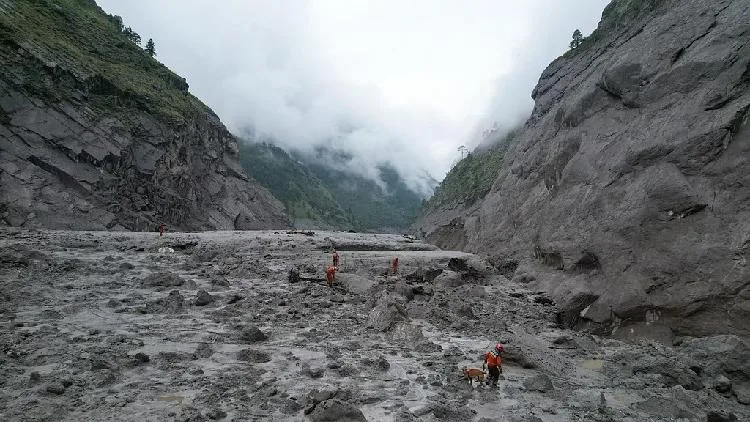
The catastrophic mudslide that struck the China-Nepal border on August 26 was triggered by a large-scale glacier collapse in Nepal with a close link to the impacts of global climate change, said Amodmani Dixit, a senior Nepalese geologist and seismologist, in an interview, calling for deeper practical cooperation of the two countries to address climate-related disasters in the Himalayas.
Dixit, who is currently conducting research at the Aerospace Information Research Institute of the Chinese Academy of Sciences, is a leading expert in Nepal's disaster studies.
He has long focused on geological structure research, earthquake monitoring, cross-border geological hazard prevention, as well as training of disaster response professionals.
He has provided specialized disaster-response training in more than 10 countries.
Dixit explained the mechanism behind the disaster during an interview with China Media Group on Saturday.
Driven by sustained global warming, extensive and abnormal melting of glaciers and snow cover across high-altitude areas of the Himalayas weakened high-elevation ice-rock formations and undermined their stability, ultimately leading to the collapse, Dixit said.
The glacier collapse generated strong geological vibrations.
Meanwhile, falling ice and rock rushed down mountain channels, picking up loose glacial debris along the way and evolving into a high-speed debris flow with enormous destructive power, eventually becoming a transboundary mudslide that caused severe damage.
Harsh conditions challenging rescue efforts The disaster's remote, high-altitude location has created significant difficulties for rescue operations, Dixit said.
The area's steep terrain, extreme weather conditions and limited working space have complicated search and rescue efforts, medical treatment and emergency relief.
He suggested that Nepal should actively coordinate with China to seek professional assistance and technical support, drawing on China's experience in emergency response systems, specialized rescue equipment and resource coordination to improve the efficiency of post-disaster operations and minimize losses.
Cooperation key to addressing Himalayan risks Dixit said the Himalayas are a shared ecological asset for Nepal and China and that protecting border-region ecosystems and managing cross-border geological and climate-related hazards are common responsibilities for both countries.
The expert praised China's disaster prevention and mitigation capabilities, highlighting its extensive experience in hazard monitoring and early warning, disaster information sharing, emergency rescue, and post-disaster recovery.
此摘要由5News从媒体的公开信息源汇聚而成。 包含完整背景的全文在www.cgtn.com — 内容归CGTN Nature (oficial)所有。