Breathing in death: How mining dust in the Aravallis is killing residents
Account subscription benefits alongside Premium Stories, Editorials, Opinions and more. Unlock these with Subscription
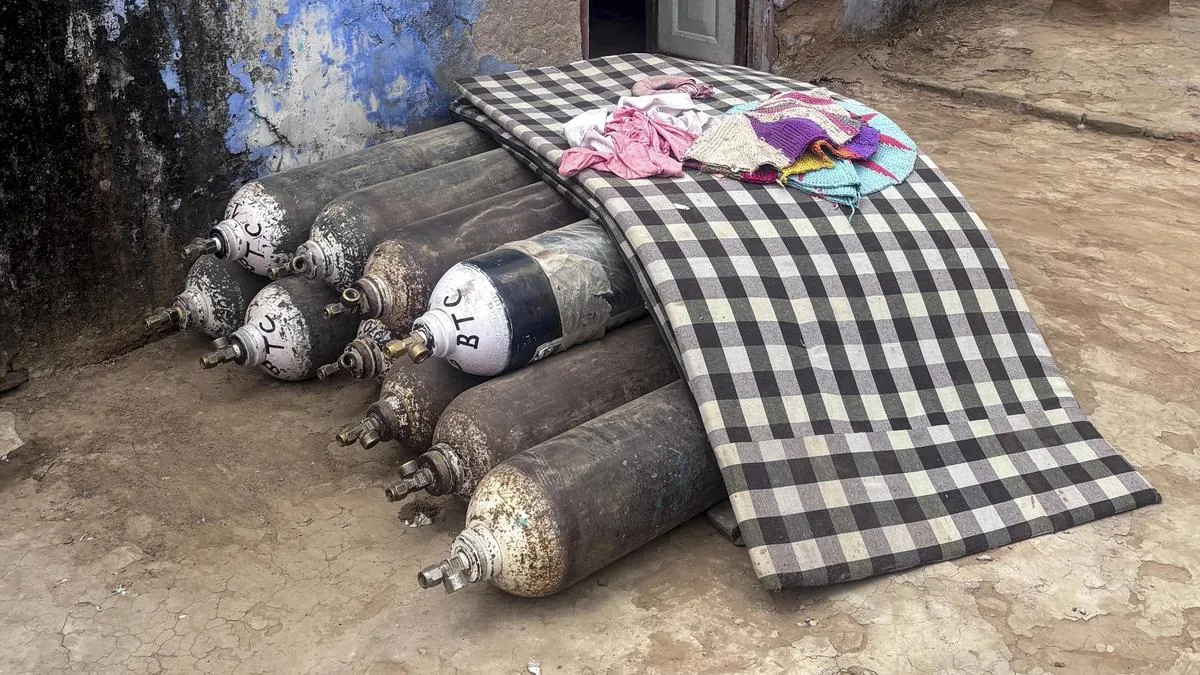
Oxygen cylinders stacked at the house of Manisha, whose husband, Manjit, died from silicosis in Sikar's Syalodra village, Rajasthan. | Photo Credit: PTI
Manisha (27), sits with a group of women on a mattress laid out in one corner of the veranda of her house in Syalodra village in Rajasthan’s Sikar district. In the other corner are stacks of large oxygen cylinders that her husband, Manjeet (32), used to breathe until his recent death.
Manjeet was a labourer at a nearby stone crushing unit, and for more than three years he had silicosis, a debilitating, incurable lung disease. It is caused by inhaling silica dust, fine particles that are a by-product of mining operations such as drilling, blasting and stone crushing in the region.
Residents say silicosis has claimed the lives of more than 50 people over the years in Syalodra, which is part of the Aravalli range.
However, the Supreme Court-appointed panel, which concluded its field visits to assess several aspects of the Aravallis on Tuesday (August 11, 2026), did not come to the village, much like it skipped many other mining-affected areas across Kotputli-Behror and Sikar districts, according to activists and residents.
Manisha, a homemaker and mother of two young children, says: “We have spent most of our savings on my husband’s treatment. Yet, no one from the administration has talked to us or come to help.”
The Committee has been conducting an independent review of the Centre’s report on the definition and delineation of the Aravallis, where decades of mining have worsened air pollution. This has caused respiratory diseases among mine workers and people living close to mining sites.
Pradeep with the photo of his father, Manoj, who died from silicosis in July, in Sikar's Syalodra village, Rajasthan. | Photo Credit: PTI
The panel’s final report, due November 30, 2026, can address these issues by establishing ecological boundaries in and around the range. But among the affected people, there is not much hope, especially after the Supreme Court recently refused to extend the submission deadline by six months. The original deadline was August 31, 2026.
Sanjay (43), lives a few steps away from Manisha’s house. In July, his brother, Manoj, who also worked at a stone crushing unit, died of silicosis. The disease has claimed six members of his family.
“We do not have the money to move somewhere else. My kids have to live here and breathe the same poisonous air which has killed so many residents,” he says.
A 2023 study, ‘Prevalence of Silicosis in Stone Carving and Sandstone Mining Industry in Rajasthan’, published in the Journal of Occupational and Environmental Medicine , examined the Rajasthan government’s online portal for the registration, certification and disbursement of relief to silicosis-affected persons. The portal was launched under the Rajasthan Policy on Pneumoconiosis including Silicosis Detection, Prevention, Control and Rehabilitation-2019.
At the time of the study, 23,436 cases of silicosis, including 6,876 deaths, had been certified on the portal.
5News aggregated this summary from the outlet’s public feed. The full article, with all the context, is on www.thehindu.com — the content belongs to The Hindu - National.