Garbage dumping in Bengaluru’s lakes turns fatal for Indian darters
Account subscription benefits alongside Premium Stories, Editorials, Opinions and more. Unlock these with Subscription
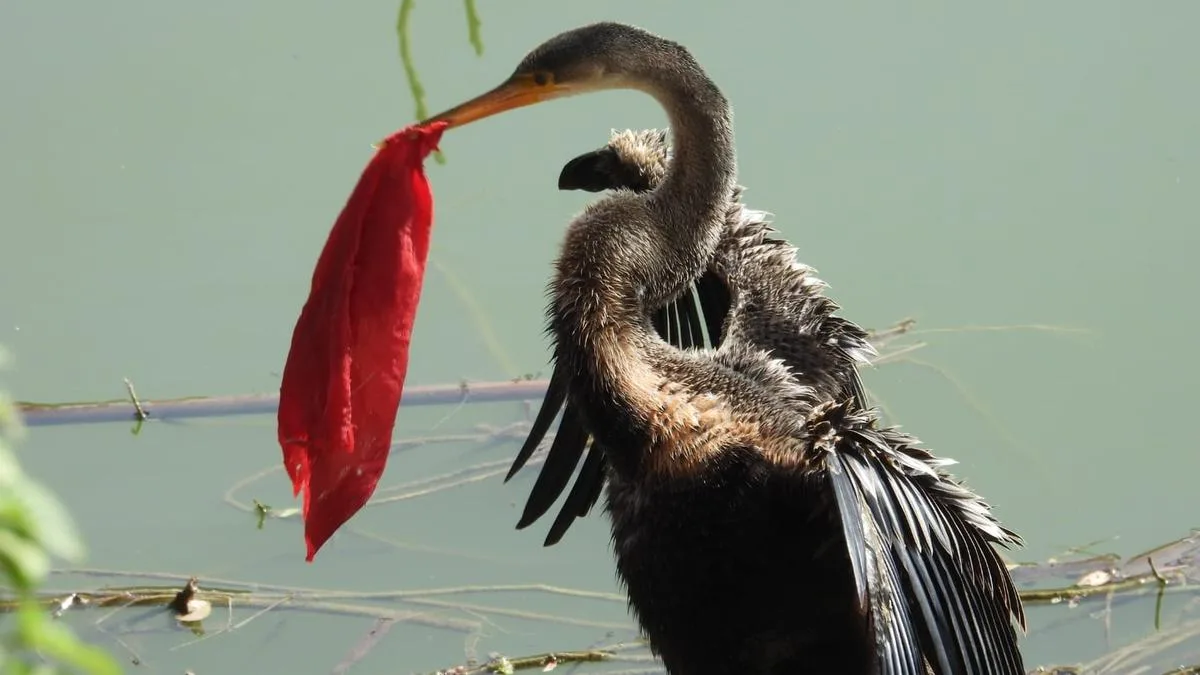
A darter with cloth stuck in its beak | Photo Credit: Special Arrangement
Renuka Selvamani, a birder and bird photographer, has noticed a strange phenomenon at her regular haunt, Doddanekundi Lake. “I am seeing more cases of birds in distress,” she says, pointing out that the culprit is trash dumped by humans. The Oriental or Indian darter ( Anhinga melanogaste r), also known as the snakebird, a tropical water bird with a long, slender neck and a sharp, spear-like beak that it uses to impale fish, seems to be afflicted more than others, Renuka says.
“The darters are very sensitive because of their beaks, which get entangled in waste, such as the net used to pack onions,” explains Renuka, who works as a data scientist with the Expedia Group. She adds that when this happens, they cannot hunt or feed themselves, and end up starving to death. “I have seen three birds whose beaks have been tied like this,” she says.
And this is not happening only at Doddanekundi Lake. According to Jayanthi Kallam, the Executive Director of the Avian and Reptile Rehabilitation Centre (ARRC) in Horamavu, there is a surge in the number of darters in distress reported from at least 10 lakes in the city. She points out that there have been sightings at lakes like Doddanekundi, Jakkur, Yelahanka, Rachenahalli, Hesarghatta, Sampengahalli, Lalbagh and Chelkere, among others.
While the issue itself is not a new one — the darters’ pointed beaks, adapted to spear fish, have always been vulnerable to the large quantities of garbage regularly dumped in the city’s water bodies — the number of birds in distress that have been spotted has gone up considerably this year, says Jayanthi. “We would get a couple of birds every year. But this year we are seeing a sudden surge in the numbers,” she says, adding that ARRC now sees at least one case every week. “Also, a lot of bird watching groups and lake groups are reporting more and more sightings.”
Certain types of garbage seem to be causing most of the danger, says Jayanthi: plastic wrappers or bags, discarded fishing nets and puja items. “People who discard puja cloth don’t even realise the dangers of it, but these tiny pieces of cloth, bright in colour, end up attracting the birds,” she says. Their beaks get tangled in these bits of cloth, and they can’t remove them. “Unlike some birds, like raptors, for instance, who can lift their legs and clean their beak, darters are not built like that. They will wiggle and shake their head, but it is very difficult for them to get something out once it is stuck.”
Darters’ are more vulnerable to rubbish because of the shape of their beak | Photo Credit: Special Arrangement
Additionally, since they are flighted birds, rescuing them also becomes difficult. “We have a team dedicated to this…use a motorised boat, drone tracking and binoculars.
5News aggregated this summary from the outlet’s public feed. The full article, with all the context, is on www.thehindu.com — the content belongs to The Hindu.