Stock returns vs earnings: Why strong profit growth may not always make you money
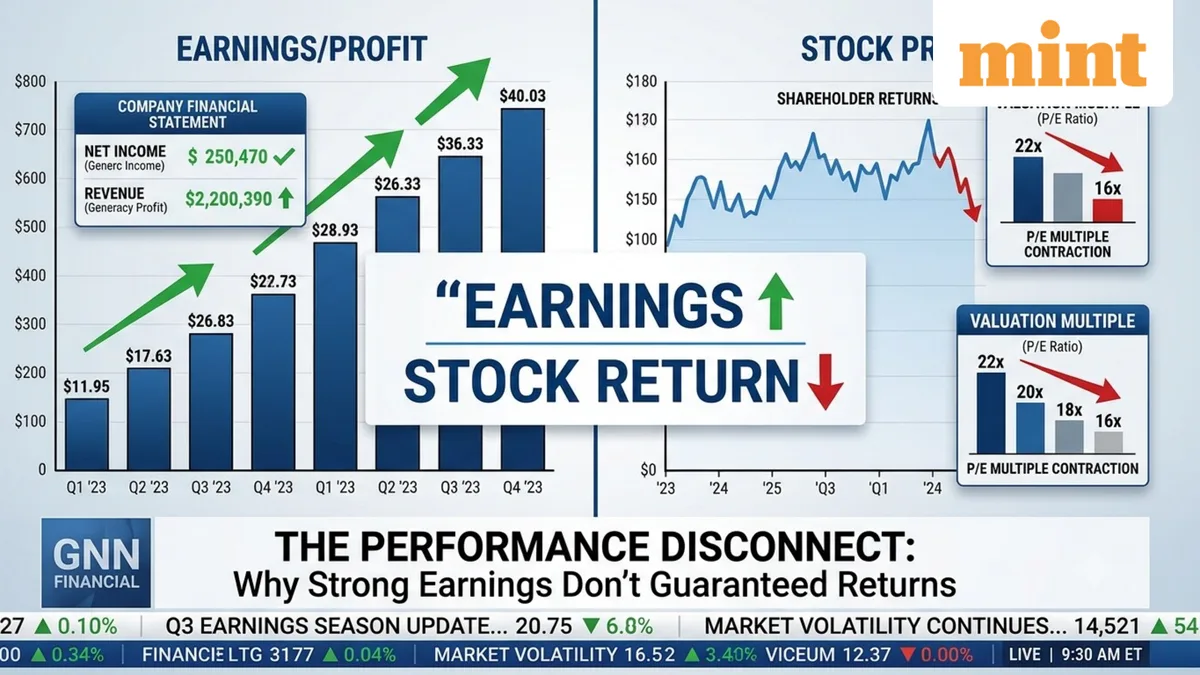
Investors often focus on whether a company can grow its earnings over the next few years. But strong profit growth alone does not guarantee that the stock will generate good returns.
A recent investor letter from Carnelian Asset Management & Advisors highlights another risk investors need to track: valuation de-rating.
The firm uses the example of HDFC Bank , where profits compounded at about 20% between 2019 and 2026, while the stock delivered a negative 5% return over the period.
Carnelian explains a stock’s return through two components: earnings and valuation multiple. If earnings rise and investors are willing to pay a higher multiple, the stock can benefit from both profit growth and a valuation re-rating.
Carnelian calls such stocks “MAGIC” — companies where earnings growth and valuation expansion work together.
But the opposite can also happen. If earnings rise while the valuation multiple falls, much of the benefit of profit growth can be offset. This is what it describes as “de-rating”.
“Finding MAGIC is only half the job; avoiding de-rating matters just as much,” the letter notes.
Its analysis of 272 BSE 500 companies with more than 10 years of trading history found that 110 companies de-rated by 5% or more between March 2016 and March 2026. These companies grew profits at a 15% CAGR, while their market capitalisation grew at a 10% CAGR.
In contrast, the 162 companies that re-rated saw profits grow at a 12% CAGR, while their market capitalisation increased at a 17% CAGR.
According to Carnelian, one reason is comfort with companies that have delivered consistently in the past. Investors may continue to value a company based on its historical reputation even when the rate of growth or other fundamentals begin changing.
The letter points to HDFC Bank, where institutional ownership stood at about 83.5%, arguing that heavy ownership can leave fewer incremental buyers to push valuations higher.
Another risk is the excitement around a “next big thing”. Investors can end up paying very high valuations for a promising theme before earnings have caught up.
The more serious situation arises when both earnings and valuation fall. Carnelian identifies several potential triggers, including stronger competition, regulatory changes, governance concerns, and large acquisitions or capital expenditure.
For example, the letter highlights how the entry of Jio changed the telecom industry's economics, hurting profitability and valuations.
5News aggregated this summary from the outlet’s public feed. The full article, with all the context, is on www.livemint.com — the content belongs to LiveMint - Money.