Rare freshwater swamps in the Western Ghats are on the cusp of extinction
Account subscription benefits alongside Premium Stories, Editorials, Opinions and more. Unlock these with Subscription
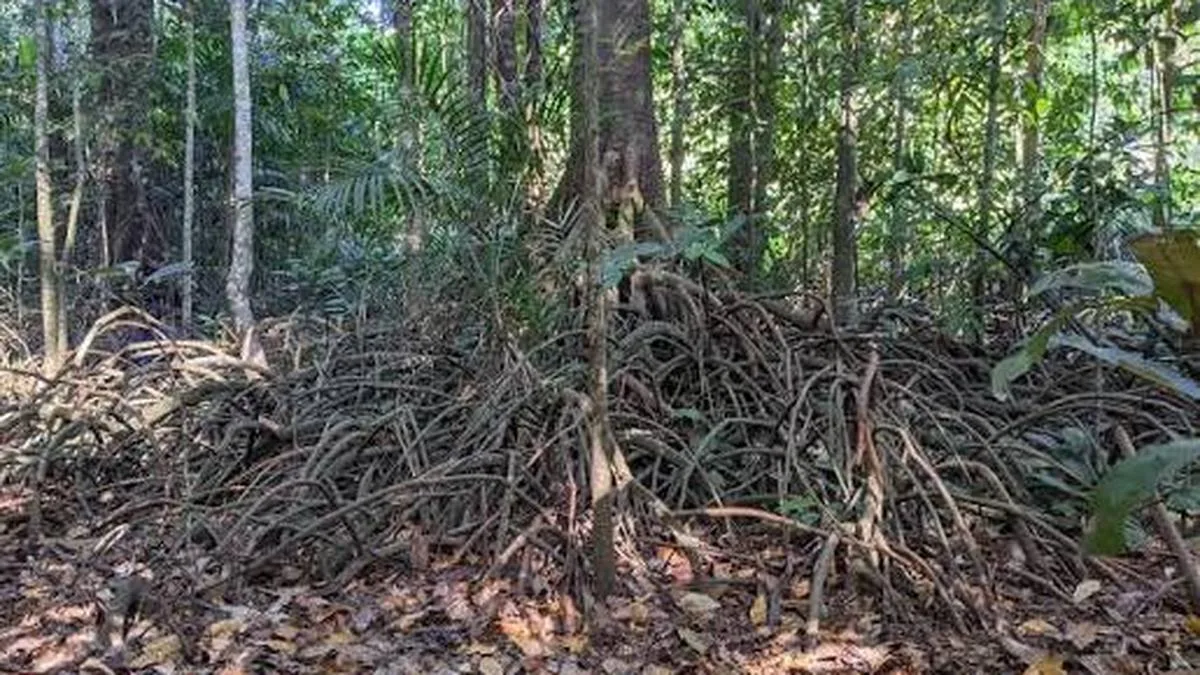
Freshwater swamp forests occupy no more than 2.1 per cent of the Earth’s surface. | Photo Credit: Wikimedia Commons
In the heart of the Western Ghats lies a rare conglomeration of freshwater swamps, restricted to a patch in Kulathupuzha, Kerala: it consists of plants with pneumatophores (aerial roots that grow vertically out of water) and stilt roots adapted to waterlogged conditions and they support a plethora of fauna. They are ecologically crucial in regulating floods, recharging groundwater, offering a perennial flow of freshwater.
But, these ‘Myristica swamps’ that represent “one of the most primitive” ecosystems in India, are under siege from logging and conversion into paddy fields or tea plantations and areca nut, oil palm, and teak farms, cautioned a paper published in Current Science.
The conservation of these swamps requires urgent habitat protection, biodiversity documentation and molecular tools such as DNA barcoding to identify species and long-term ecosystem management, the paper added.
While mangrove forests , such as in the Sundarbans, exist in brackish and saltwater habitats, freshwater swamps in the tropics grow on fertile alluvial, waterlogged soils in the plains. Freshwater swamp forests occupy no more than 2.1 per cent of the Earth’s surface. The genetic variety of Myristica swamps dates back an astonishing 500 million years.
“Freshwater forest mounds and ridges produce a network of complicated thin channels that drain the forest to nearby rivers and streams, maintaining coastal water flow and removing silt, sediment and pollutants from flowing water,” said the paper.
Earlier research found that these swamps contain more than half of Kerala’s amphibians, 26 per cent of birds, 23 per cent of butterflies, more than 20 per cent of reptiles, 11 percent of spiders, 8.4 per cent of fish, and 6.6 per cent of mammal species of the State.
These old swamps are so rare that they occur only in the Western Ghats (below 15.50°N); the Andaman and Nicobar Islands support a small distribution too.
5News aggregated this summary from the outlet’s public feed. The full article, with all the context, is on www.thehindu.com — the content belongs to The Hindu - Sci-Tech.