Supreme Court agrees to give ‘precedence’ hearing to plea against Delhi SIR
Account subscription benefits alongside Premium Stories, Editorials, Opinions and more. Unlock these with Subscription
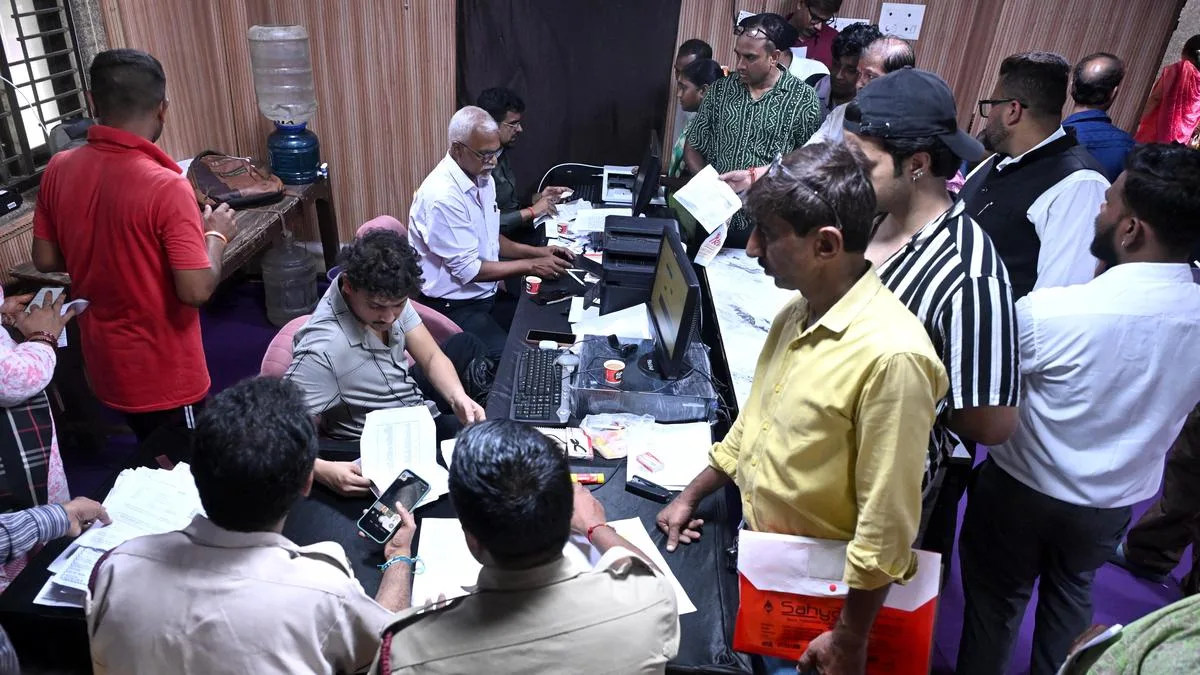
Voters who recieved notices to prove eligibility in ongoing Special Intensive Revision (SIR) drive, queue at designated location with documents in New Delhi on September 16, 2026. | Photo Credit: Shashi Shekhar Kashyap
The Supreme Court on Thursday (September 17, 2026) agreed to give “precedence” in hearing to a writ petition raising discrepancies in the conduct of the Special Intensive Revision (SIR) of the electoral roll in Delhi, including the removal of lakhs of voters from the draft roll for nebulous reasons.
“We will list it on Monday (September 21, 2026). Such matters will have precedence,” Chief Justice of India (CJI) Surya Kant said.
Also Read: Delhi SIR: Mismatch between hearings scheduled, elector turnout at centres as Oct. 29 deadline looms
The CJI was reacting to an oral mentioning by advocates Prashant Bhushan and Neha Rathi of a petition filed by activists Anjali Bhardwaj and Amrita Johri.
The plea flagged that apart from the more than 47 lakh names that have been removed as per the draft roll, the Election Commission of India (ECI) was preparing notices to 33 lakh people on two grounds: logical discrepancies and mapping.
“Out of 97,53,577 electors who are listed on the draft Delhi SIR roll after the enumeration phase, 33,12,919 electors (33.96%) are being issued notices after being identified for either having no mapping (13,79,785) or for logical discrepancies (19,33,134). However, the respondents (Election Commission and the Chief Electoral Officer, Delhi) have failed to publish the list of electors to whom notices have been issued along with the specific basis thereof, contrary to the procedure,” the petition said.
The petition said the term ‘logical discrepancies’ has neither been defined by the EC nor has any specific criteria or parameters to determine the circumstances in which an elector would fall within that category. No document or instruction has been placed on the website.
In the West Bengal SIR, ‘logical discrepancies’ could include anything from improbable family age gaps and changing parent names to entries backed by only Aadhaar. ‘Mapping’ meant the exercise of verifying voters’ details with earlier records or their families’ generational voting data gleaned from previous electoral rolls.
“This lack of information would make the notice process susceptible to arbitrary and inconsistent application. It would also deprive the elector of a meaningful opportunity to understand and rebut,” Mr. Bhushan submitted.
He said the actual notices being issued were “completely vague and devoid of specific facts or grounds”.
With the notice phase for Delhi SIR concluding on October 29, the issuance of vague notices would make lakhs of electors vulnerable to an arbitrary process of potential disenfranchisement.
The petition urged the Supreme Court to direct the respondents to forthwith place in the public domain, including on the Chief Electoral Officer’s website and on notice boards of local bodies, the list of all electors issued notices during the SIR exercise.
5News aggregated this summary from the outlet’s public feed. The full article, with all the context, is on www.thehindu.com — the content belongs to The Hindu - National.