The rural-urban divide in female labour force participation
Account subscription benefits alongside Premium Stories, Editorials, Opinions and more. Unlock these with Subscription
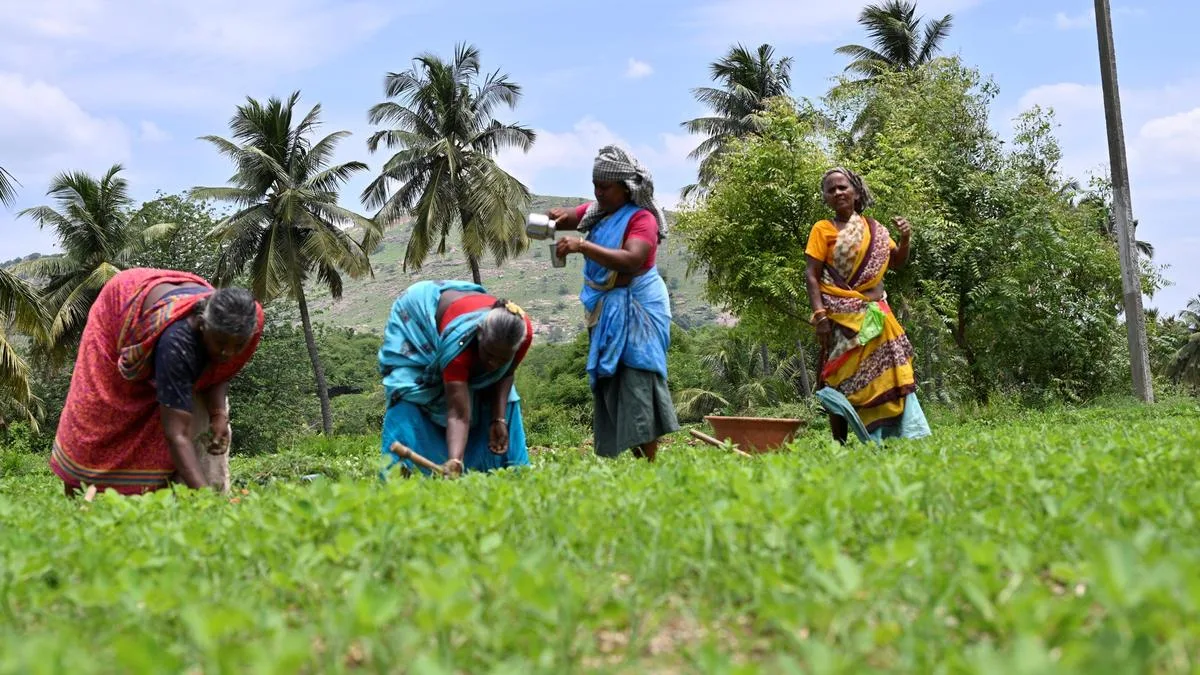
Agricultural Women labourers weed out groundnut field on the hot afternoon water pot is placed on field to beat the heat in-between their work water being share to consume at Nayakaneri village,vellore district. | Photo Credit: VENKATACHALAPATHY C
The Periodic Labour Force Survey (PLFS) 2025 reveals a significant increase in the Female Labour Force Participation rate (FLFPR) since 2020, following the COVID-19 pandemic. The overall FLFPR for those aged 15 years and above increased from 30% in 2019-20 to 40% in 2025. The increase was more pronounced in rural areas, where the FLFPR rose from 33% to 45.9%, compared with an increase from 23.3% to 27.7% in urban areas. This substantial rural–urban difference warrants a more granular, State-level analysis of female labour force participation for rural and urban areas, excluding Union Territories and North-Eastern States, to understand how individual States have performed since the pandemic.
The chart below shows the Average Annual Percentage Point (AAPP) change in rural FLFPR for each State between 2019-20 and 2025.
AAPP is used to indicate the pace of improvement and is not intended to rank states. West Bengal, Uttar Pradesh, Gujarat, Odisha, Bihar, Rajasthan and Haryana recorded AAPP above the all-India rural average. In contrast, Madhya Pradesh, Punjab, Jharkhand, Chhattisgarh, Uttarakhand, Maharashtra, Goa, Himachal Pradesh and the five southern States recorded AAPP below the national average; but most continued to register positive annual changes.
Rajasthan and Gujarat, with AAPP above 2 percentage points per year, recorded particularly sturdy improvements. Uttarakhand, Kerala, Chhattisgarh, Karnataka, Odisha, Bihar and Andhra Pradesh also recorded AAPP above the all-India urban average. In contrast, the remaining States recorded AAPP below the national average and Goa recorded a negative AAAP. This indicates that several States recorded relatively strong gains despite overall pace of improvement being lower in urban areas than in rural areas.
However, AAPP alone is insufficient as it measures only the pace of change and does not consider the level of female labour force participation from which a State started. Therefore, combining the baseline level — 2019-20 FLFPR for each State — with the AAPP helps better assess the States.
Bihar, Uttar Pradesh, West Bengal and Haryana started with relatively low female LFPR but recorded AAPP above the all-India average, indicating a relatively faster pace of improvement. In contrast, Goa and Punjab started from relatively low baseline levels but recorded AAPP below the national average, indicating slower improvement despite having considerable scope. Odisha, Gujarat and Rajasthan started with relatively higher baseline rural FLFPR and recorded an above-all-India-average AAPP, indicating that faster improvement is not confined to States starting from a low base.
5News aggregated this summary from the outlet’s public feed. The full article, with all the context, is on www.thehindu.com — the content belongs to The Hindu - National.