₹20,000 extra every month: Why paying off your personal loan first may win over an SIP
Got a pay raise? Have extra ₹ 20,000 every month? But how to decide what to do with the money: repay your personal loan faster or start investing it through a mutual fund SIP?
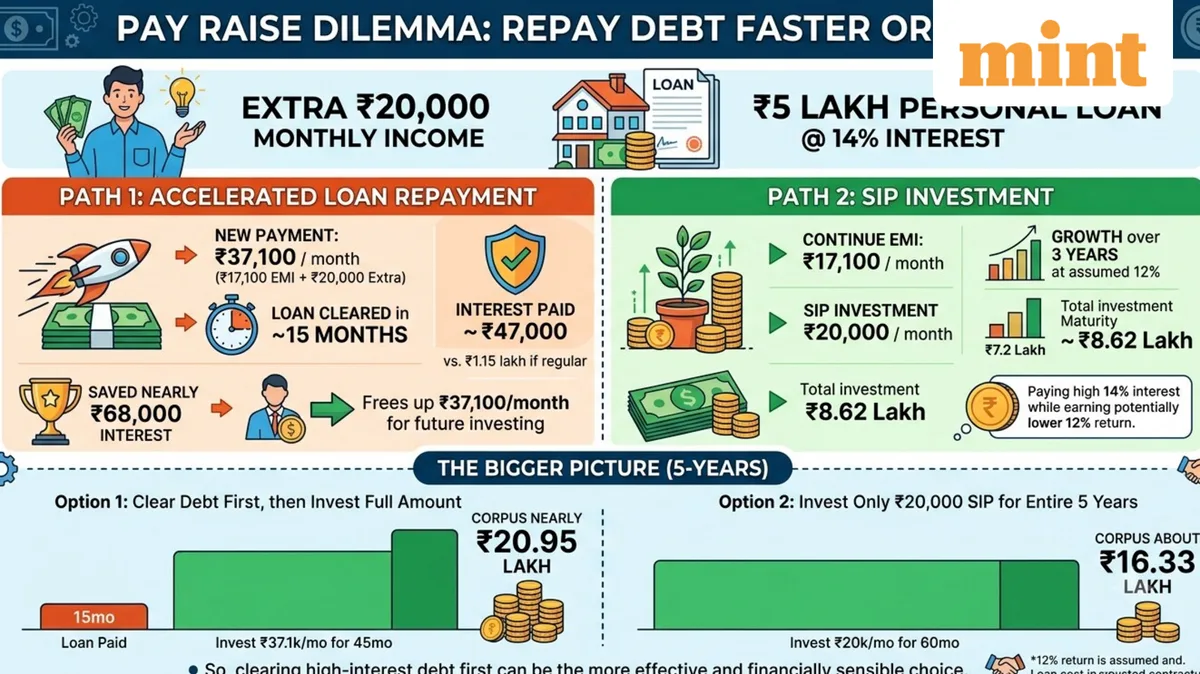
Let's assume you have a ₹ 5 lakh personal loan at 14% interest for three years. The monthly EMI works out to roughly ₹ 17,100. If you continue paying only the EMI, you would pay about ₹ 1.15 lakh in interest over the full tenure.
Now, after you get a raise, you suddenly have an additional ₹ 20,000 every month, and with that you can:
That way, instead of paying ₹ 17,100, you pay around ₹ 37,100 a month towards the loan. That way, the ₹ 5 lakh loan could be cleared in about 15 months. So now, you pay roughly ₹ 47,000 in interest and save nearly ₹ 68,000 compared with sticking to the original repayment schedule.
There is another advantage. Once the loan is cleared, you are free of EMI and can redirect the entire ₹ 37,100 per month towards investments.
Suppose you continue paying the ₹ 17,100 EMI and invest the additional ₹ 20,000 every month in an equity mutual fund SIP.
If the SIP earns an assumed 12% annualised return, ₹ 20,000 invested every month for three years could grow to roughly ₹ 8.62 lakh, against total investments of ₹ 7.2 lakh.
Obviously, this looks attractive. But if you dig deeper, the bigger picture unfolds.
If you first clear the loan in about 15 months and then invest the full ₹ 37,100 every month for the remaining 45 months, the corpus will be nearly ₹ 20.95 lakh after five years at a12% annual return.
In contrast, investing only ₹ 20,000 every month for the entire five years would create a corpus of about ₹ 16.33 lakh.
(12% return is only an assumption, while the 14% loan cost is contractual.)
So, for a high-interest personal loan, clearing the debt first can be the more effective and financially sensible choice. Once the loan is paid off, the freed-up EMI can be redirected to investments.
The decision can change if the personal loan rate is relatively low, or if the investment horizon is very long. Borrowers should also check whether their lender charges any prepayment or foreclosure fee before making extra payments.
Sanchari Ghosh is an Assistant Editor at Mint with over 12 years of experience in journalism, specialising in personal finance, DLT & DeFi, geopolitics and foreign policy, with a particular emphasis on how these areas intersect. <br> She writes extensively about how money works in everyday life—helping readers navigate personal finance decisions. <br> As AI reshapes investing behaviour, capital is increasingly flowing into decentralized ecosystems, redefining how assets are managed, traded, and valued. She focuses on explaining how money flows within frameworks like Distributed Ledger Technology (DLT), DeFi protocols, and crypto markets—while also exploring what the future of money could look like in a trustless, programmable financial world. <br> She also focuses on immigration-related issues, simplifying complex topics around visas, passports, overseas financial planning, and the many practical challenges Indians face while moving or living abroad.
5News aggregated this summary from the outlet’s public feed. The full article, with all the context, is on www.livemint.com — the content belongs to LiveMint - Money.