‘The Love Hypothesis’ movie review: A charming rom-com that disappoints book-tok
Account subscription benefits alongside Premium Stories, Editorials, Opinions and more. Unlock these with Subscription
Movies based on books are going to be rushed. Movies based on books are going to be rushed. Movies based on books are going to be rushed.
This is the what I repeated to mentally prepare myself before hitting play on Amazon Prime’s awaited adaptation of The Love Hypothesis , based on the book of the same name by Ali Hazelwood.
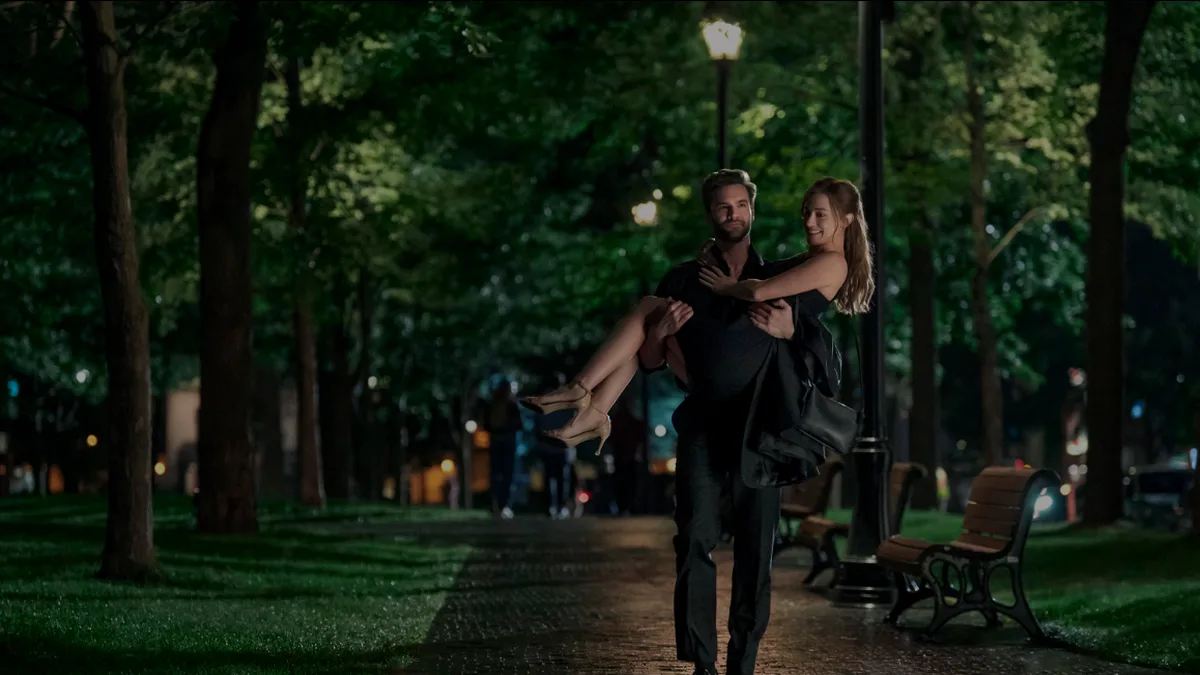
The story centres on Olive Smith (Lili Reinhart), a dedicated third-year biology PhD candidate at Stanford University, whose research focuses on the early detection of pancreatic cancer. Her carefully ordered life gets complicated when her best friend, Anh (Rachel Marsh), falls for Olive’s crush but refuses to pursue him out of loyalty to her friend. Desperate to convince Anh that she has moved on, Olive claims she is dating someone and, when Anh nearly catches her working late in the lab, impulsively kisses the first man she encounters in the hallway.
Unfortunately for Olive, that random bystander is Dr Adam Carlsen (Tom Bateman), a notoriously stern and hypercritical biology professor nicknamed ‘Dr Evil’, whose reputation is enough to strike fear into the hearts of Stanford’s graduate students. Rather than report her rather spectacular lapse in judgement, Adam unexpectedly agrees to play along with Olive’s lie — though he has his own motives of using the arrangement to prove career stability.
What begins as a mutually beneficial transaction soon turns into mandatory coffee dates, increasingly inconvenient proximity and inevitably, the kind of chemistry neither of the two very smart scientists accounted for.
The film delivers a breezy, lighthearted narrative that hits all the classic rom-com beats. In a classic grumpy X sunshine pairing, Adam and Olive are drawn together by the familiar friction of his glower meeting her irrepressible optimism, their differences slowly giving way to enough chemistry that makes the formula feel fresh again.
But the film could have benefited from giving the two characters more time to occupy the uncertainty instead of using up the screentime in party games and flashbacks. As a result, the relationship arrives at its destination after a brief montage of Olive preparing for her big presentation.
The movie also stumbles in its execution of comedic set-pieces. There is a scene where Olive applies sunscreen on Adam’s back after Anh compels her to. One can feel the awkwardness seep through the screen when Olive bursts out in loud laughter to make it seem like flirting and I wanted to wince more than Adam did.
Adapting a book always requires trimming excess foliage, and while fan-favorite secondary characters like Adam’s best friend Holden are left on the cutting room floor, the omission serves the purpose of stripping the story down to its emotional core.
This plays out really well in the third act. Rather than relying on clunky, convenient contrivances (like an accidental audio recording miraculously catching a villain red-handed) the movie transforms the academic misconduct storyline into something far more grounded and direct.
5News aggregated this summary from the outlet’s public feed. The full article, with all the context, is on www.thehindu.com — the content belongs to The Hindu.