Using thunderquakes to X-ray earth – a new study shows urban seismology in action
Account subscription benefits alongside Premium Stories, Editorials, Opinions and more. Unlock these with Subscription
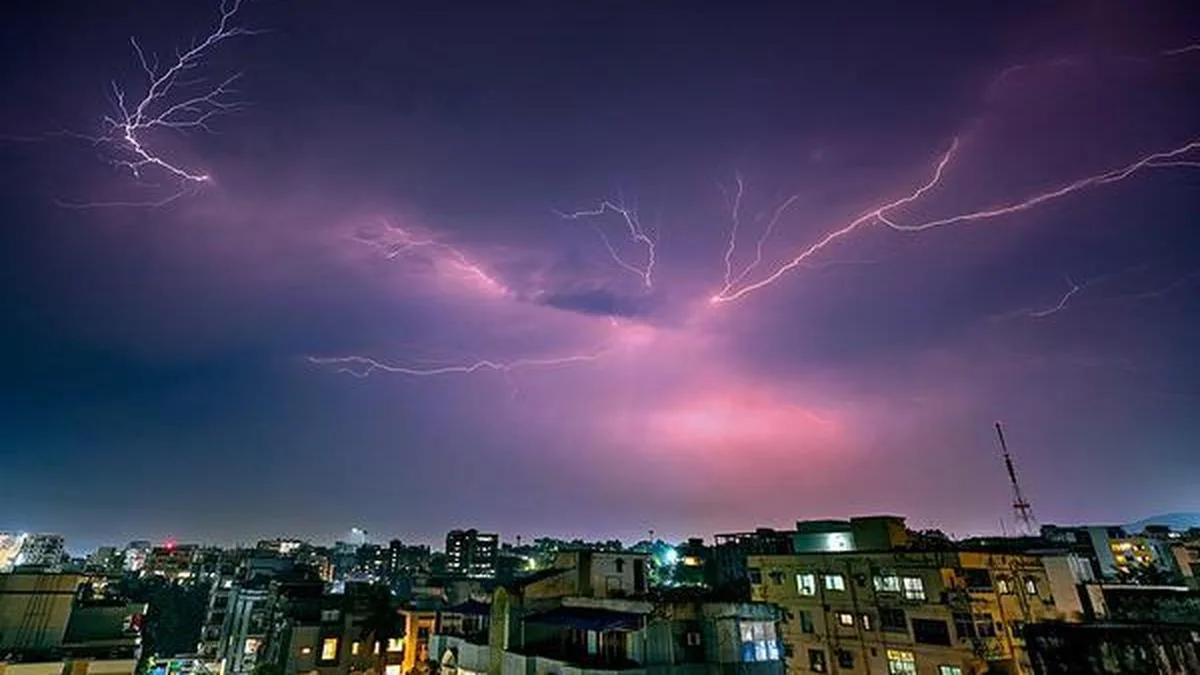
Lightning illuminates the night sky over Visakhapatnam after an evening shower on Monday, August 10, 2026. | Photo Credit: K.R. Deepak/The Hindu
When lightning strikes, it superheats the air around it and creates a shock wave that we hear as thunder. But thunder doesn’t just travel through the atmosphere to our ears.
When that energy reaches the ground, some of it is converted into seismic waves that ripple through the soil and rock beneath. The resulting vibrations are known as thunderquakes.
Until now, scientists haven’t understood these signals well enough to make practical use of them. Our team’s research shows that thunderquakes can be used to map the structure beneath the Earth’s subsurface – such as groundwater movement, environmental contamination, sinkholes, or for evaluating building sites and foundations – just like X-rays image inside the human body.
We discovered this by listening to thunder with something found in communities around the world but unusual as a seismic measuring instrument: fibre-optic cable.
Using a technique called distributed acoustic sensing, we turned an ordinary fiber-optic cable, the kind used for internet or phone service, into a string of thousands of vibration sensors.
A laser-pulsing computer, called an interrogator, sends light through the cable and measures tiny changes caused by vibrations along its length. In our experiment, part of the Penn State FORESEE project, we used a cable that is over 2 miles (more than 4 kilometers) long. That gave us more than 2,100 sensors, spaced only a few feet apart, all listening to the ground at once.
Over two years, we used an old telecom fiber to record and identify 458 clear, high-quality thunderquakes.
The enormous amount of detail captured by this process has allowed us to see something that had been difficult to observe before: specific types of seismic waves produced when sound from the atmosphere interacts with the ground.
The most important of these seismic waves are what we call air-coupled Rayleigh waves. They are measurable at the surface but can be used to study the subsurface far below, even down 300 feet (around 100 meters).
The trick to this technique is known as seismic dispersion: Waves of different frequencies travel at different depths. By measuring how the thunderquake’s wave speeds changed with frequency, we could reconstruct the seismic wave speed at different depths, which allows us to interpret the properties of the ground beneath the fibre.
The result was the equivalent of an X-ray of the subsurface extending roughly 300 feet underground, without drilling a single hole.
Imaging the subsurface typically requires specialized equipment, such as truck-mounted vibration sources or arrays of sensors that have to be installed for surveys. These approaches can be expensive and difficult to deploy over large areas.
5News aggregated this summary from the outlet’s public feed. The full article, with all the context, is on www.thehindu.com — the content belongs to The Hindu - Sci-Tech.