Hope flows anew with revival of Andhra’s Veligonda project
Account subscription benefits alongside Premium Stories, Editorials, Opinions and more. Unlock these with Subscription
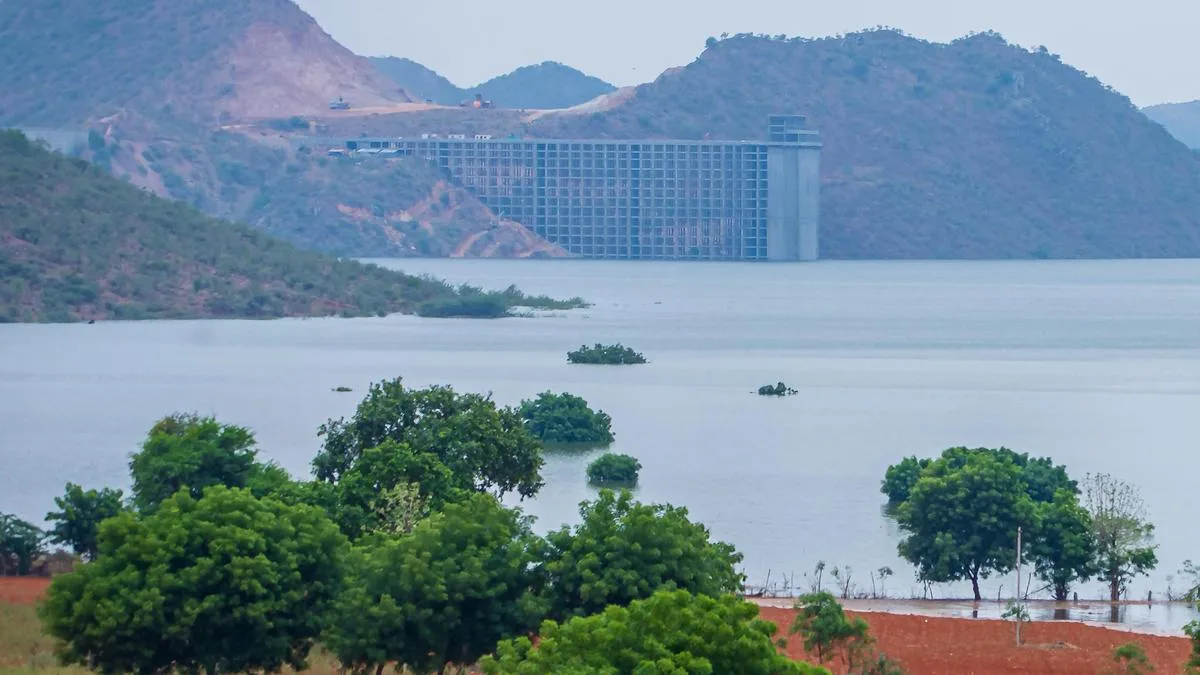
Krishna water fills the Nallamalasagar reservoir at the Gottiadiya and Sunkesula dams near Markapuram. | Photo Credit: KOMMURI SRINIVAS
The Poola Subbaiah Veligonda Project (PSVP) gained significant momentum on August 31, 2026, when Chief Minister Nara Chandrababu Naidu released Krishna water into Nallamalasagar through the twin tunnels and feeder canal. The project is designed to draw 43.50 TMC of Krishna floodwater from the foreshore of the Srisailam Reservoir , through Kollam Vagu, and traversing across the Nallamala hills to Nallamalasagar.
Conceived as a long-term response to chronic drought, depleted water resources, and fluoride contamination in parts of the region, the project aims to create a large irrigation network while extending drinking water facilities to drought-prone populations.
For nearly four decades, the people of the region have been battling water scarcity issues, combined with groundwater fluoride levels that are ten times higher than permissible levels. The project has been planned as a permanent water supply intervention, combining irrigation, drinking water provision, and groundwater recharge.
Reflecting the scale of this initiative, the project’s financial framework places the revised estimated cost at ₹10,790 crore, of which a major portion of ₹7,607 crore has already been spent.
According to the official record, the Nallamalasagar Reservoir, formed by closing the Sunkesula, Gottipadia, and Kakarla gaps in the Nallamala hills, has a gross storage capacity of 53.85 TMC, including 43.50 TMC of live storage and 10.35 TMC of dead storage. Its full reservoir level is +244.000 metres, and the minimum drawdown level is +214.300 metres. The water spread area is stated to be 52.40 square kilometres, with a peripheral length of 76 km.
The project identifies 36.57 TMC as the crop water requirement, 1.570 TMC for drinking water and 3.360 TMC towards anticipated evaporation losses. The overall irrigation command is proposed at 4,47,300 acres, comprising 4,32,500 acres of irrigation development ayacut and 14,800 acres of stabilised ayacut.
Another component of the project is that the irrigation network spans four districts and 30 mandals. The district-wise figures indicate 308,700 acres in Markapuram, 27,400 acres in Prakasam, 84,000 acres in SPSR Nellore, and 27,200 acres in YSR Kadapa. The Markapuram component includes 302,200 acres of irrigation development ayacut and 6,500 acres of stabilised ayacut. SPSR Nellore has 77,500 acres of irrigation development ayacut and 6,500 acres of stabilised ayacut, while YSR Kadapa has 25,400 acres and 1,800 acres, respectively. Prakasam has 27,400 acres of irrigation development ayacut.
While at the constituency level, the proposed irrigation coverage includes Yerragondapalem, Markapuram, Giddalur, Kanigiri, Darsi and Kondepi in the Markapuram and Prakasam areas; Badvel in YSR Kadapa; and Udayagiri and Atmakur in Nellore.
5News aggregated this summary from the outlet’s public feed. The full article, with all the context, is on www.thehindu.com — the content belongs to The Hindu - National.