Why has the U.S. deployed ‘weapons’ in space? | Explained
Account subscription benefits alongside Premium Stories, Editorials, Opinions and more. Unlock these with Subscription
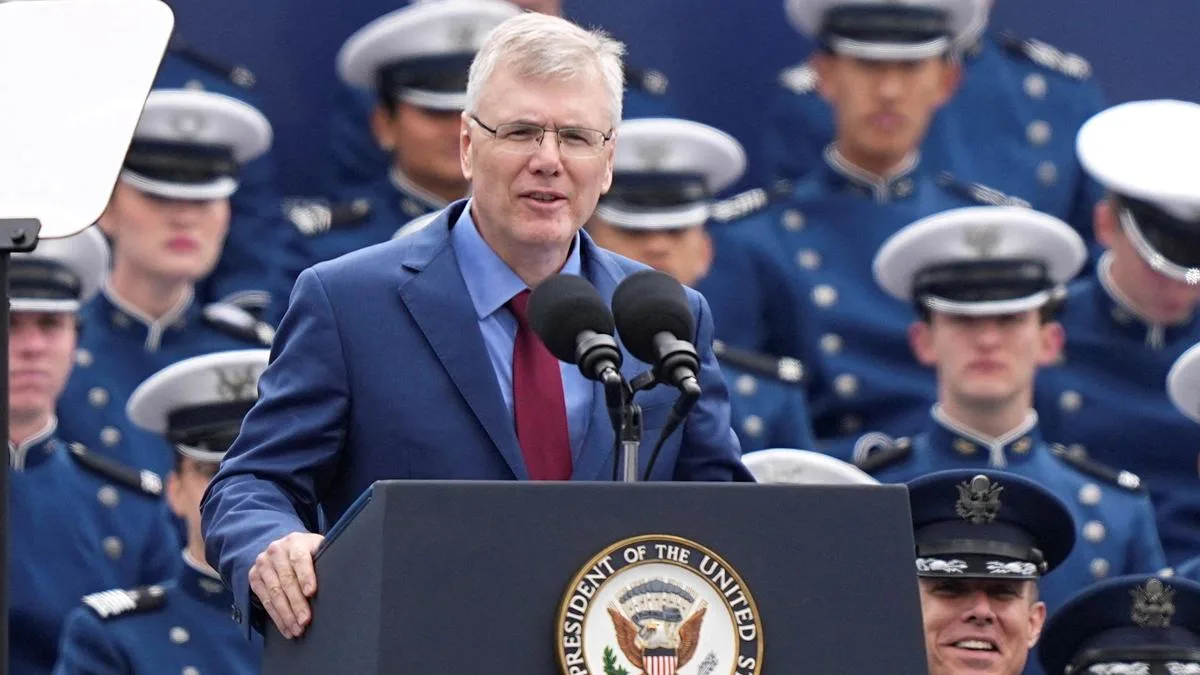
U.S. Air Force secretary Troy Meink said the country has “space control” weapons deployed in Earth’s orbit to defend U.S. forces against “hostile adversary action”. | Photo Credit: Reuters
On September 14, 2026, U.S. Air Force secretary Troy Meink said the country has “space control” weapons deployed in Earth’s orbit to defend U.S. forces against “hostile adversary action”. The disclosure drew backlash from Russia and China, among other quarters.
As per the U.S. Space Force, ‘space control’ refers to military activities required to control the space domain. In 2025, the then-Space Force chief, Gen. Chance Saltzman, said such a device could possess both “kinetic and non-kinetic” capabilities and could disrupt or degrade an adversary’s capabilities.
‘Kinetic’ generally refers to physically damaging an object through impact, such as by smashing into it. Non-kinetic methods include electromagnetic interference that can jam or spoof a satellite’s communications, and directed energy systems that interfere with its sensors.
In fact, the current Space Force war-fighting framework recognises three kinds of counter-space operations: orbital, electromagnetic, and cyberspace.
We do not know. We also do not know how many units/instances of the system exist, what they are capable of, which orbits they are in, and whether they are kinetic or non-kinetic. Mr. Meink had said that while disclosing the weapon’s (or weapons’) existence would contribute to deterrence, revealing their operational details would subtract from the deterrence. There is also no indication whether these weapons are the same as the space-based interceptors the U.S. government has planned for the ‘Golden Dome’ missile defence programme. These interceptors are still undergoing tests.
Mr. Meink has referred to “hostile adversary action”. Incumbent Space Force chief Gen. Douglas Schiess has also referred to “space-enabled attacks”.
In other instances over the years, U.S. officials have repeatedly singled out Russian and Chinese counter-space capabilities as reasons for their government to develop similar capabilities of its own, to protect its own satellites. Russia and China have also demonstrated sophisticated satellite manoeuvres in orbit.
For example, in 2020, two Russian satellites manoeuvred close to a U.S. government satellite, prompting the Space Command to call the behaviour potentially threatening. In 2022, the Chinese Shijian-21 satellite used a robotic arm to tow a defunct Chinese geostationary satellite into a graveyard orbit.
However, we do not know the circumstances in which the U.S. will use its weapons as the government has not published the rules of engagement for orbital weapons.
The relevant instrument is the Outer Space Treaty, which entered into force in 1967, during the Cold War and the nuclear arms race between the U.S. and the Soviet Union. It prohibits its party states, which include the U.S., Russia, and China today, from placing nuclear weapons or other weapons of mass destruction in orbit or stationing them elsewhere in outer space.
5News aggregated this summary from the outlet’s public feed. The full article, with all the context, is on www.thehindu.com — the content belongs to The Hindu - International.