Around Madras city in hand-pulled rickshaws
Account subscription benefits alongside Premium Stories, Editorials, Opinions and more. Unlock these with Subscription
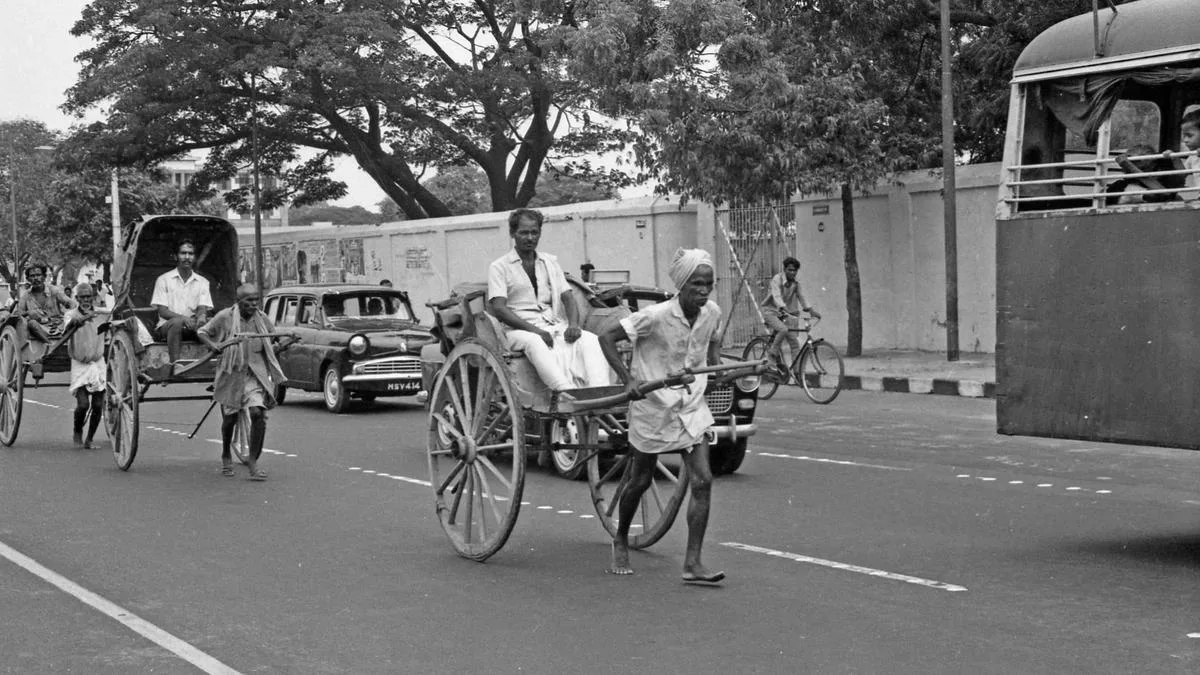
The Japanese name for a rickshaw is jinrikisha. It can be broken up into jin (human), riki (powered), and sha (vehicle). | Photo Credit: The Hindu Archives
The Vaideekar Pattina Pravesam referred to in an earlier article in this supplement also has the orthodox villager setting his eyes on a hand-pulled rickshaw for the first time. He asks if an ostrich is meant to draw this along as the yoke is too high for a bullock. When told it is a man, he is horrified and comments that to live in the city you need to stifle your conscience.
Who but the down and out would want to eke out a living by hoisting a passenger on to their vehicle and dragging them around on foot? Bimal Roy’s Do Bigha Zamin (1953) really brought the pathos to the fore with Balraj Sahni as the bankrupt villager forced to become a rickshaw puller in Calcutta. Five years later, J.P. Chandrababu brought comedy to the task, in Sabash Meena (1958). It was also the first time perhaps that a major character spoke Madras Bhashai in a Tamil film.
Rickshaw was an import from Japan, the original name jinrikisha can be broken up into jin (human), riki (powered), and sha (vehicle).
Hand-pulled rickshaws made their appearance early in 20 th Century Madras. People found it a convenience, ignoring the bad design and the havoc it caused on the rickshawpuller in the long run.
In 1938, Rev. C.W. Ransom, in his pathbreaking A City In Transition, Studies in the Social Life of Madras noted that “the rickshaw is a small two-wheeled gig, pulled by a coolie and it is not uncommon to see a wretched coolie struggling along with two heavy adults in his vehicle. It is a cheap but slow method of transport and involves a type of human labour which is open to serious criticism.
A sensitive person can hardly ride with comfort behind the strained and sweating back of a fellow human being, or feel justified in thus employing him as a beast of burden.”
The rickshaws needed two licences, one from the Corporation and other from the police. Getting even one was not easy, so illegal vehicles multiplied. Handpulled rickshaws were ultimately banned on December 20, 1973. | Photo Credit: The Hindu Archives
The rickshaws needed two licences, one from the Corporation and other from the police. Getting even one was not easy, so illegal vehicles multiplied.
An idea of the ratio can be had from The Hindu ’ s April 13, 1973 edition announcing the end of handpulled rickshaws. That year, to celeb-rate the 50 th birthday of M. Karunanidhi, the Government resolved to replace all 2,000 hand-pulled rickshaws with the mechanised equivalents. That was the official number. But, as early as the 1950s, 6,000 rickshaw pullers had received free raincoats from M.G.
5News aggregated this summary from the outlet’s public feed. The full article, with all the context, is on www.thehindu.com — the content belongs to The Hindu - National.