Ganesh Utsav as social remittance in the Hindi heartland
Account subscription benefits alongside Premium Stories, Editorials, Opinions and more. Unlock these with Subscription
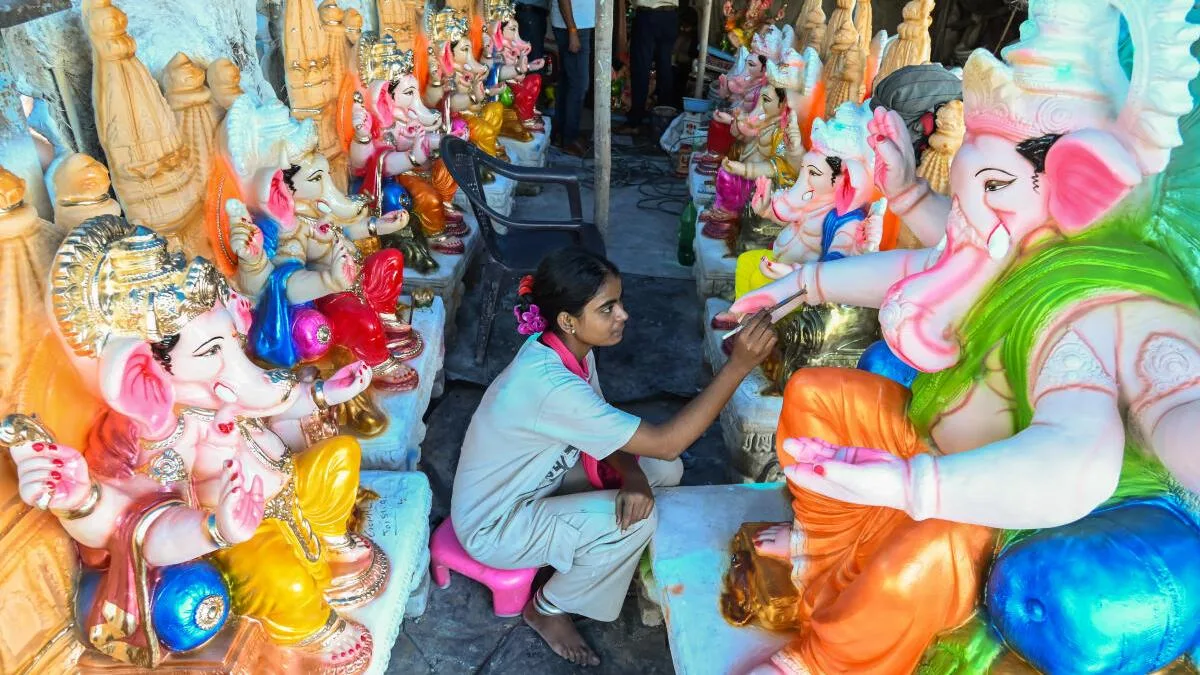
A female artisan appies paints and gives final touches to idols of lord Ganesh ahead of the Ganesh Chaturthi festival, in Patna on 12 September, 2026, Friday.
Several videos of events related to Ganesh Utsav from Bihar and Uttar Pradesh surfacing online this year prompted me to make some inquiries. Ganesh Utsav, which used to be largely confined to Maharashtra, has travelled east to the Hindi heartland. The increasing popularity of Ganesh Utsav in the Hindi heartland is a marker of the social remittance of the migrants who travel between these States. It also suggests an increasing nationalisation of culture aided by social media consumption, alongside the movement of people.
I spoke to friends in Gorakhpur, U.P.; and Madhubani, Bihar, who said that in recent years Ganesh Utsav events are increasingly part of the local calendar. In Krishnipatti village in Madhubani, there were two events in recent days: the first, a one-day programme organised by a Dalit man; the second, a five-day affair organised by a member of the Yadav community.
Both have ties to Maharashtra, where they remain connected. The Dalit man, Mohan Ram, is linked to the Congress party locally, while Ranjan Raj Yadav is associated with the RJD. Mr. Ram’s event might cost several thousands, while Mr. Yadav’s had a budget of several lakhs. The second one also involved a performance by Annapurna Yadav, an emerging Bhojpuri singer. “Ganesh Utsav events started in our village in the last five to seven years,” a resident told me.
It is not that the Ganesh Utsav celebration is unknown in the heartland. In 1893, Bal Gangadhar Tilak turned what used to be a private affair of Ganesh puja around Chaturthi into a public celebration, in Marathi regions. It was a tool to overcome the restrictions on political assembly by the British. Within four years, in 1897, Varanasi had a public Ganesh Utsav, but that was largely by the Marathis who lived there. The public processions and pandals gained quick popularity in the western part of India, serving as part politics and part religion. Marathi families that moved to other parts of the country carried the custom through the 20th century. Kanpur, Lucknow, and Varanasi began to have Ganesh Utsav pandals.
What seems different now is that people of the heartland who travel to the west coast of India return to their native places with new cultural learnings. The Ganesh Utsav, due to its hugely public character, becomes a marker of this social and cultural remittance. In Maharashtra itself, the Utsav pandals have grown into massive cultural enterprises. “Many pandals now have budgets of several crores of rupees. Small players can no longer think of setting one up any longer,” a politician from Maharashtra told me.
As we can see, there is a transformation of the festival itself as it travels to new territories, and what passes off as cultural performances along with worship and piety. The same issue is relevant in the context of the controversy around the visit of the spiritual head of the Swaminarayan sect to Paris this month.
5News aggregated this summary from the outlet’s public feed. The full article, with all the context, is on www.thehindu.com — the content belongs to The Hindu.