Madras city on the move: a compilation
Account subscription benefits alongside Premium Stories, Editorials, Opinions and more. Unlock these with Subscription
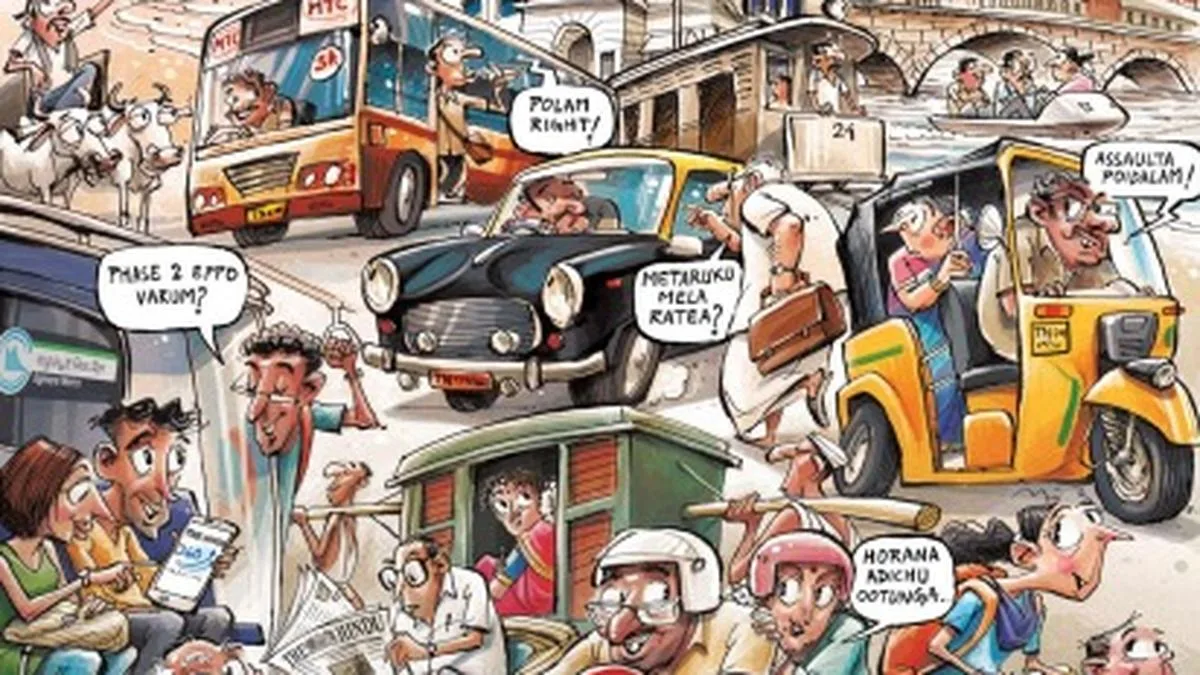
On the palimpsest of Madras, we have rewritten the way we travel, by foot, boats, carts, carriages, and coaches, palanquins, tramways, trains, two-wheelers, cars and buses, aircraft, and, now, metro rail. Illustration by Soumyadip Sinha
Public transport is an abiding feature of city life. Madras that is Chennai is no different. As we look back at the history of this city, and trace farther back in time to eras when colonial Madras did not exist but several villages, which were absorbed into it certainly did, we see that stories of movement are a constant. Walking is the oldest mode and still survives despite every impediment in its way. The well-to-do rode on horses, were driven about in carriages, or carried in palanquins. The colonials, when they arrived, adopted the same methods of conveyance as the locals but these eventually evolved. And from then on, it has been a continuous journey, by different modes.
A palimpsest is defined as a manuscript or parchment where the original has been partially or fully erased, to enable fresh writing. The topography of Madras is much the same, the change always brought about by the need for quick access to places. A metropolis, unlike a rural hamlet, needed to enable quick commutes — and so passageways and conveyances had to be available at the double. In the process, we never entirely got rid of what methods and routes existed in the past. And they survive, in bits and pieces here and there, to teach us history.
In the pre-colonial days, we had the concept of veethis , which almost certainly were the equivalent of high roads. They were meant for providing easy access from one self-contained village to another. Madras arose in their midst and demanded routes unto itself, which did not exist earlier. It was therefore transport that defined the primary topography of the colonial city. In the neighbouring Old Black Town, before the Esplanade and later the High Court and the law college obliterated all traces, the streets were defined on the basis of caste, and then easy access. New Black Town, which is today’s George Town, still carries vestiges of that layout.
As the city expanded and absorbed neighbouring villages into itself, roads came about to connect the Fort and George Town to the rest of the areas. These were not so much a priority as were those that needed to connect to weekend getaways and later garden bungalows of the East India Company servants. These, which today form the arterial thoroughfares of the city, carry in their (old) names that story of the purpose for which they were originally laid out - providing ease of access for the colonials to reach their homes. That these came to be the principal highways of the city on which public transport would eventually depend is a delicious twist of history. It is only with the emergence of planned localities, such as T. Nagar, Shenoy Nagar, and K.K. Nagar, that layouts were made with public accessibility as the principal criteria.
5News aggregated this summary from the outlet’s public feed. The full article, with all the context, is on www.thehindu.com — the content belongs to The Hindu - National.