Kalam connect: what made him the ‘People’s President’?
Account subscription benefits alongside Premium Stories, Editorials, Opinions and more. Unlock these with Subscription
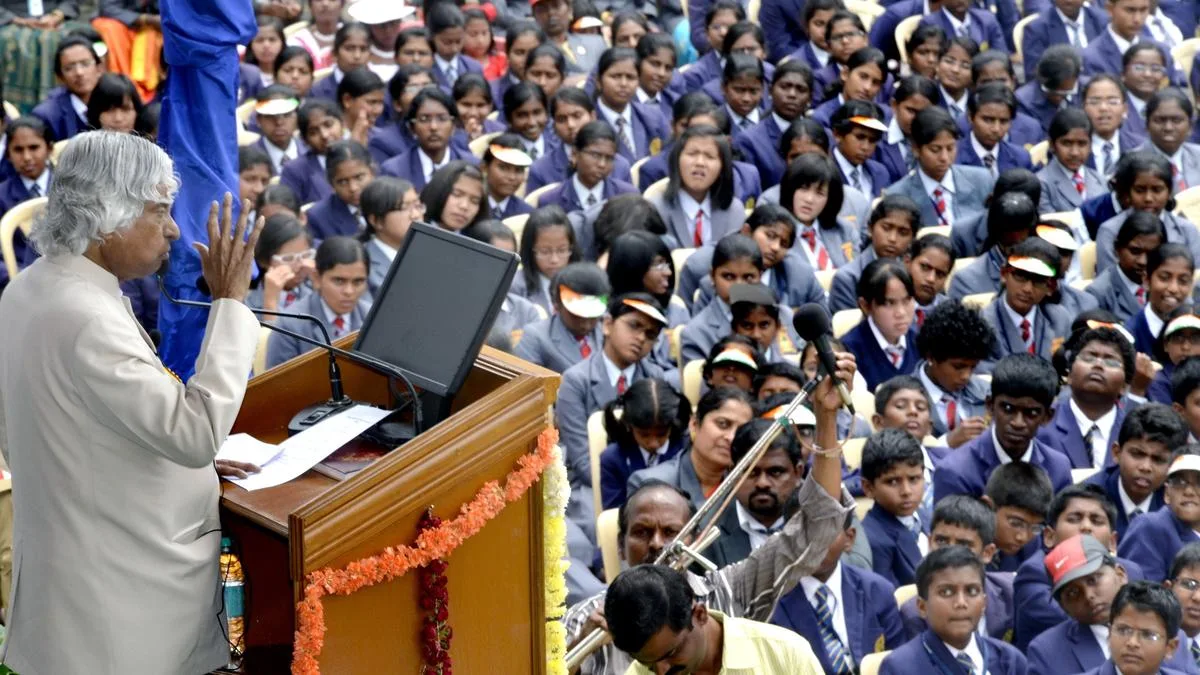
Former President Dr. A. P. .J. Abdul Kalam addressing students in Yercaud in 2013. | Photo Credit: The Hindu
In the years leading up to India’s independence, a boy was born in the south Indian town of Rameswaram in Tamil Nadu on October 15, 1931. That boy was the youngest of five siblings in a once wealthy family that found itself in difficult times. Despite the circumstances in which he was raised, he stuck with his education. When the country gained independence from British rule, one can imagine the teenager dreaming up a future — for himself, and for his country. He surely set out and achieved all of them, and perhaps more, as Avul Pakir Jainulabdeen Abdul Kalam became one of the most beloved Presidents that the country has ever seen.
With a degree in aeronautical engineering from the Madras Institute of Technology, Dr. Kalam went on to make significant contributions as an Indian scientist. As someone who spent most of his time in the 21st Century meeting and inspiring people, it is easy to forget that Dr. Kalam had spent many decades before that in the 20th Century as a working scientist who put a young independent nation on the world map. Having joined the Defence Research and Development Organisation (DRDO) in 1958, Dr. Kalam switched over to the Indian Space Research Organisation (ISRO) in 1969, before heading back to DRDO in 1982.
Flanked by Dr. Satish Dhawan (second from left), Dr. Kalam (second from right) shows an album of photographs to Prime Minister Indira Gandhi following the successful launching of SLV-III in 1980 | Photo Credit: The Hindu Archives
From being the project director of the SLV-III (India’s first indigenous Satellite Launch Vehicle that was both designed and produced in the country) to planning the Integrated Guided Missile Development Programme (IGMDP) that produced a number of successful missiles, Dr. Kalam had plenty of successes in his career.
“All birds find shelter during a rain. But eagle avoids rain by flying above the clouds. Problems are common, but attitude makes the difference!!!” Dr. Abdul Kalam
The decades that followed saw recognition and accolades come in thick and fast. These included some of India’s highest honours: the Padma Bhushan, Padma Vibhushan, and the Bharat Ratna.
The first of those, the Padma Bhushan, came in 1981, with an investiture ceremony in Rashtrapati Bhavan, New Delhi on March 28, allowing Dr. Kalam to receive the award from President N. Sanjeev Reddy. After picking up the Padma Vibhushan in 1990, Dr. Kalam then served as the Scientific Adviser to Defence Minister and Secretary, Department of Defence Research & Development from July 1992 to December 1999. During this period, Dr. Kalam claimed the Bharat Ratna — the country’s highest civilian award. From 1999-2001, he served as the principal scientific adviser to the government.
The President, N. Sanjeev Reddy, conferring Padma Bhushan award to Dr. Abdul Kalam at a special investiture ceremony in Rashtrapati Bhavan, New Delhi on March 28, 1981.
5News aggregated this summary from the outlet’s public feed. The full article, with all the context, is on www.thehindu.com — the content belongs to The Hindu.