Income up to ₹12.75 lakh? Know whether you pay zero tax on capital gains too under the new tax regime
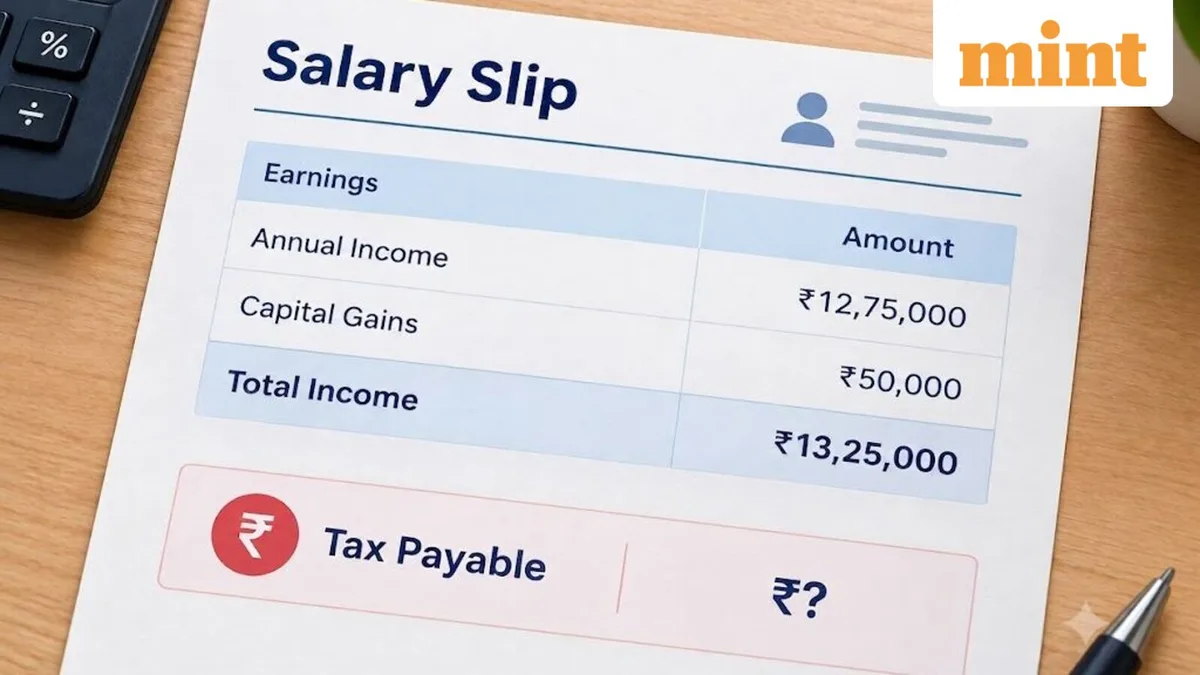
In the Union Budget for 2025-26, Finance Minister Nirmala Sitharaman announced that from financial year 2026-27, individuals earning up to ₹ 12 lakh a year would pay no income tax under the new tax regime.
For salaried taxpayers, this effective zero-tax threshold rises to ₹ 12.75 lakh after factoring in the standard deduction. While tax is still calculated according to an individual's tax slab rates, the rebate under Section 87A of the new regime offsets the liability up to the eligible income limit.
This means even though the tax on ₹ 12 lakh income would be ₹ 60,000, taxpayers do not actually pay it because of the rebate . However, capital gains are treated differently and profits from equity-oriented mutual funds or shares do not automatically qualify for the same tax benefit.
The key issue is that capital gains are generally taxed at special rates and therefore the rebate that makes normal income tax-free up to ₹ 12 lakh under the new regime does not apply to them.
The Section 87A rebate applies only to tax on normal income taxable at slab rates. It cannot be claimed against tax on income taxed at special rates, even if total income, including capital gains, does not exceed ₹ 12 lakh.
For example, short-term capital gains on listed shares are taxed at a flat rate of 20% beyond the basic exemption limit of ₹ 4 lakh, assuming the taxpayer is a resident taxpayer. If you are a non-resident, however, the 20% tax applies to the entire short-term capital gain, as non-resident taxpayers cannot adjust any shortfall in normal income against the basic exemption limit for such gains.
“The rebate cannot be used directly against tax on LTCG taxable u/s 112A. Therefore, even if a taxpayer’s total income is below ₹ 12.75 lakh, tax may still arise on taxable equity or equity oriented mutual fund gains. The ₹ 12.75 lakh figure may arise where salary income includes the ₹ 75,000 standard deduction. It should not be treated as a blanket exemption for capital gains,” said Nishant Shanker tax and FEMA expert at Navraj Global Advisors.
Capital gains arise from selling financial assets such as stocks , mutual funds, property, and gold. STCG applies when an asset is held for less than 12-24 months, depending on the type of capital asset, while LTCG applies when it is held for over 12-24 months.
STCG on specified listed equity shares, equity-oriented mutual funds and business-trust units, where the applicable STT conditions are met, are generally taxed at flat 20% under Section 111A of the Income-tax Act.
Meanwhile, long-term capital gains (LTCG) on specified assets are taxed at 12.5% under Section 112A, with the first ₹ 1.25 lakh of eligible gains exempt from tax.
“Section 87A is not available against the tax payable on such long-term capital gains. For STCG, a resident individual may be able to use any unused basic exemption limit in specified circumstances, but the special-rate gain itself is not simply covered by the Rs. 12 lakh rebate,” Shanker said.
Eshita Gain is a digital journalist at Mint, where she joined in May 2025.
5News aggregated this summary from the outlet’s public feed. The full article, with all the context, is on www.livemint.com — the content belongs to LiveMint - Money.