Onam: The many ways Keralam celebrates
Account subscription benefits alongside Premium Stories, Editorials, Opinions and more. Unlock these with Subscription
The Onam we know falls in the first month of the Malayalam calendar year, Chingam. Starting on Atham day, it is celebrated for ten days, culminating on Thiruvonam. The festival pivots around the arrival of the benevolent Asura ruler, King Mahabali, amid a dazzle of pookkalams, sadyas and payasams.
But beyond this popular narrative, there is more to Onam. It is a multi-layered construct built by myth, legend and local traditions. Celebrations take on diverse hues across regions and communities. For instance, in certain pockets of Palakkad, people start making pookkalams from the month of Karkkadakam, the month preceding Chingam. This spills over to the following month of Kanni, as well.
Girija Varier, a retired teacher from Palakkad, says that they start laying the pookkalam from Thiruvonam day in Karkkadakam and stop on Atham day in Chingam, the day when the rest of Keralam begins laying pookkalams!
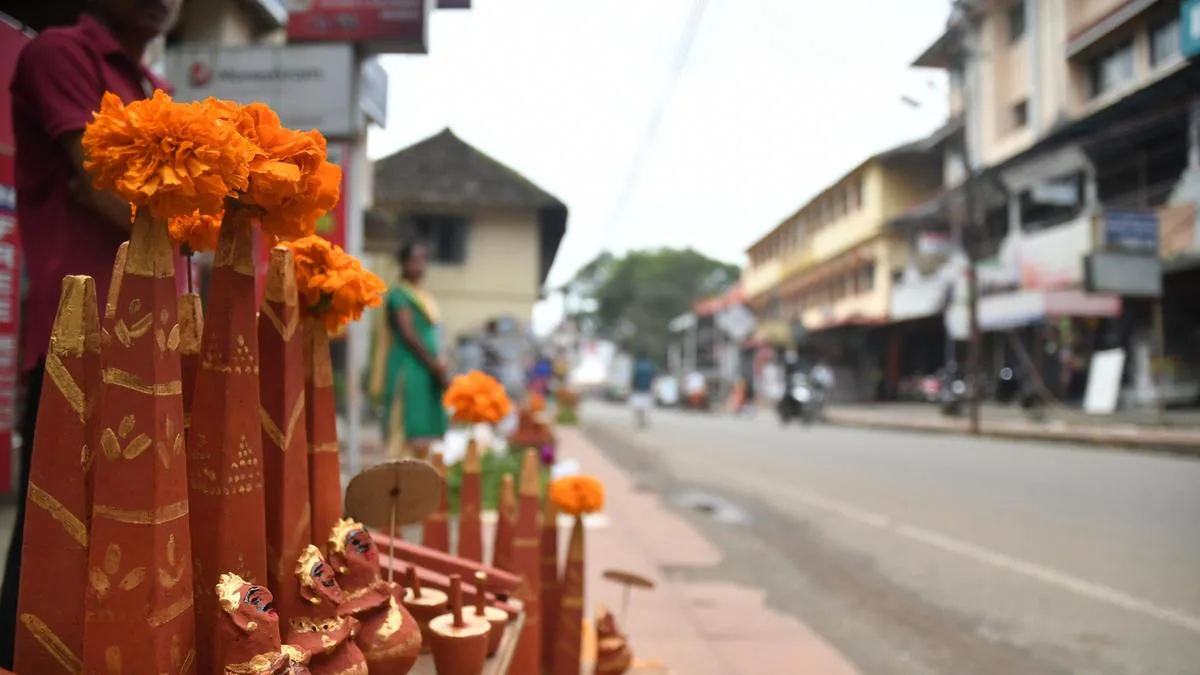
“Instead, we place pyramid-shaped figures made of clay or sand — Mathevar or Onathappan. Three of them will be placed on leaves of turmeric plant for the next six days with flowers placed on top of them. Five new ones are placed on the seventh day with turmeric leaves replaced by banana leaves. The number goes up to seven, nine and finally 21 on Thiruvonam day. In our belief, these figures symbolise Lord Vishnu. On Thiruvonam day, we place a bigger figure representing Mahabali,” says Girija. The figures are adorned with flowers and a kolam (rangoli with rice paste) decorates the space.
Girija Varier with the Onathappans arranged at her courtyard | Photo Credit: SPECIAL ARRANGEMENT
Once these figures are taken away on a specific date, they begin laying the pookkalam again. “The floral carpets will be made till the 16th day, which falls on Makam. That day, we place Makathadiyan, a figure representing Lord Siva. Made of mud, it has carvings to indicate the snake with a raised hood on his neck and the flowing river Ganga on his head.”
The pookkalam continues to be made till Ayilyam star in Kanni, believed to be the Onam day for the farming community. “That is when the paddy harvest will be over, bringing cheer to the farmers. On this day, three small figures are placed in the courtyard, named Ayilyam Unnikal. It is with Ayilyam that our Onam festivities conclude.”
Mathevar, the pyramid-like structures arranged during Onam | Photo Credit: SPECIAL ARRANGEMENT
Manjusha PP, a food blogger and history buff from Palakkad, adds that they lay the pookkalam till Uthradam day, after which the Onathappan (Thrikkakkarappan) will be placed. She also remembers making Makathadiyan and Ayilyam Unnikal.
According to historian and researcher Vellanad Ramachandran, there are certain beliefs associated with the festival followed in some parts of central Travancore in connection with the four main days of the festival — Uthradam, Thiruvonam, Avittam and Chathayam, respectively called Onnaam Onam, Randaam Onam, Moonnaam Onam and Naalaam Onam. Uthradam day is for Onathamma, who stands for King Mahabali’s wife, Vindhyavali.
5News aggregated this summary from the outlet’s public feed. The full article, with all the context, is on www.thehindu.com — the content belongs to The Hindu.