Botticelli’s Madonna and Child comes to Bengaluru
Account subscription benefits alongside Premium Stories, Editorials, Opinions and more. Unlock these with Subscription
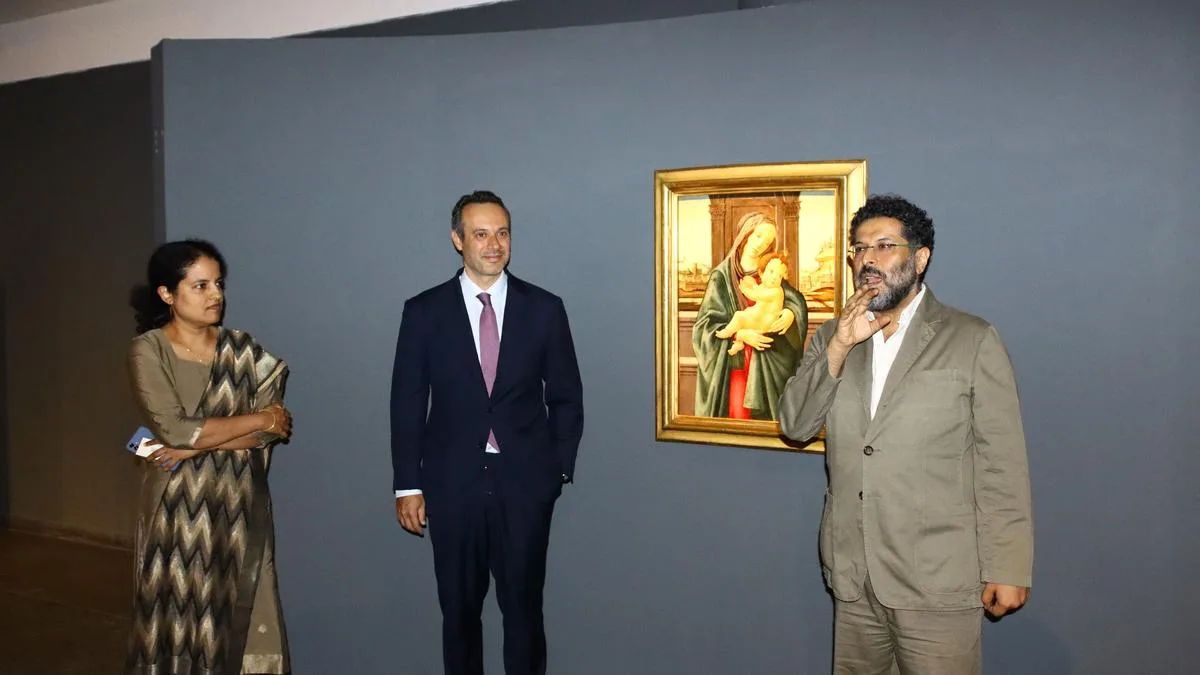
Priyanka Mary Francis, the director of NGMA Bengaluru with Giandomenico Milano, Consul General of Italy in Bengaluru and art historian and academician Naman Ahuja at One Mother, Many Mother Tongues | Photo Credit: Special Arrangement
In the centre of a darkened gallery at the National Gallery of Modern Art (NGMA), Bengaluru, Sandro Botticelli’s Madonna and Child gleams within its gilded frame. The Virgin Mother, whose alabaster skin, high forehead, hooded eyes, elongated nose and jaw, and small but pronounced Cupid’s bow bear a striking resemblence to the women in the Italian Renaissance painter’s classic masterpieces, Primavera and The Birth of Venus , is dressed in colours which hint at Christian duality: her scarlet robe signifies her humanness and eventual sacrifice, while her blue mantle represents the cosmos, a nod to the divinity she has carried within her.
In her arms, she cradles a naked, chubby male child who looks away from her into the distance, her expression deeply melancholic. “She knows what is to come,” says art historian and academician Naman Ahuja, pointing out other details in the painting that foreshadow Christ’s crucifixion, death, and resurrection, such as the architectural framing of the background, which resembles a cross, and the stone gargoyles behind Mary, a visual warning.
Sandro Botticelli’s Madonna and Child g | Photo Credit: Special Arrangement
While Botticelli’s Madonna and Child , a 93 × 73 cm tempera and oil tempera on wood panel, is indeed a masterpiece, it is not the only one on display at this new exhibition, One Mother, Many Mother Tongues , co-curated by Naman and the director of the Italian Cultural Centre in India, Andrea Anastasio. The result of a collaboration between the Consulate General of Italy in Bengaluru, the National Gallery of Modern Art (NGMA) and the Ministry of Culture, it has been supported by the Prestige Group, with Rezwan Razack’s Museum of Indian Paper Money as cultural partner.
Some of the other artworks, which are part of the exhibition, include a tiny, 4500-year-old terracotta sculpture from Harappa, a delicate ivory carving of a mother balancing a girl (the only image, which depicts a female child) on her head from Bengal, statuesque stone effigies of ancient Indian goddesses like Chamunda, Skanda Mata, Matrika, Hariti and Jyeṣṭhā and a collection of Etruscan representations of Mater Matuta, an indigenous goddess of fertility, childbirth, and ripening grain, later co-opted and syncretised by the Romans.
These artefacts, spanning geography, cultures, media, and millennia, collectively dissect how a persistent visual motif—mother and child—migrates across borders, changing identity according to region, religion, language, and culture, as the exhibition release states.
5News aggregated this summary from the outlet’s public feed. The full article, with all the context, is on www.thehindu.com — the content belongs to The Hindu.