From stars to streets: The history of Jantar Mantar in New Delhi
Account subscription benefits alongside Premium Stories, Editorials, Opinions and more. Unlock these with Subscription
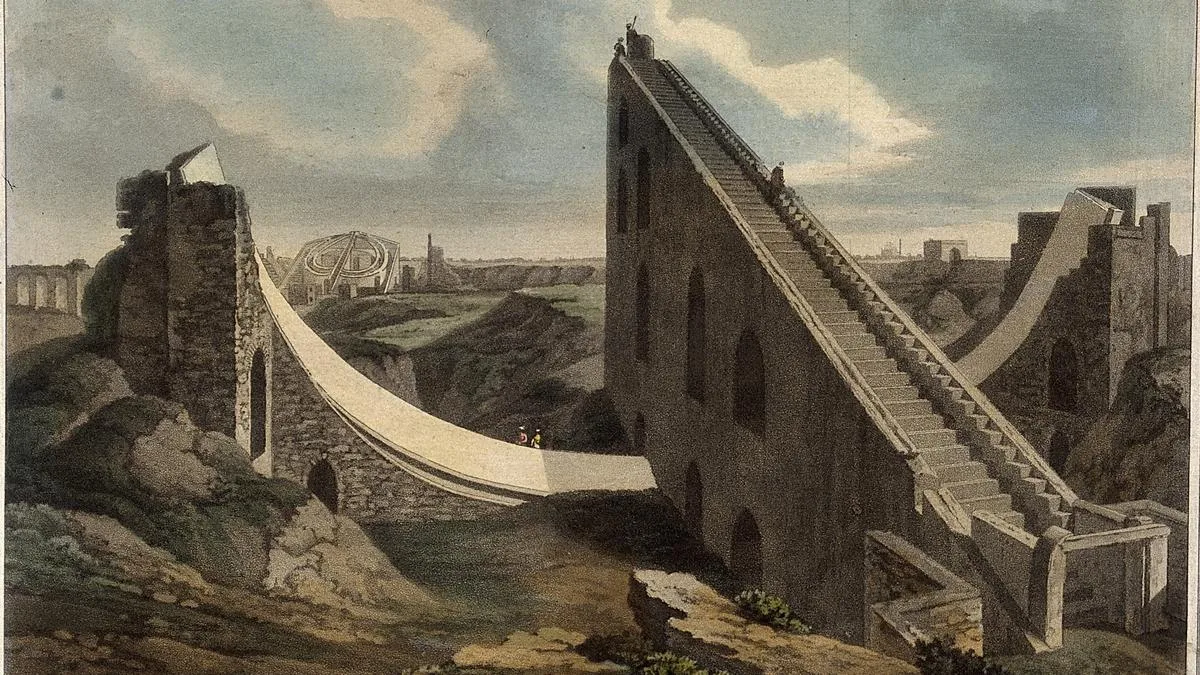
The Jantar Mantar, ca. 1790 by Thomas Daniell | Photo Credit: Special Arrangement
In January 2026, I visited Jantar Mantar, the open observatory in Delhi. It is a quaint place, with odd-looking structures decorating the complex. Most visitors to this ticketed monument are tourists from outside Delhi and it draws only a few thousands. Yet this monument, which most people skip on their itinerary, becomes one of the most Google-searched monuments in Delhi whenever there is political unrest.
As crowds have been swelling at Jantar Mantar over the past few weeks, demanding the resignation of the Chief Election Commissioner, Gyanesh Kumar, a recent update has de-notified Jantar Mantar as the official protest site.
Three new places, the Ramlila Ground, Burari Ground, and CBD Ground, East of Delhi, have been designated for organising demonstrations in the city.
But this was not always the epicentre of demonstrations in Delhi. In 1988 the capital city was rocked by a nearly week-long farmers’ protest, attended by tens of thousands at Boat Club lawn near India Gate and Rajpath (now Kartavya Path). The lawn’s proximity to Government buildings, and the sheer size of the crowds alarmed the authorities.
Jantar Mantar, Delhi Observatory, by William Daniell (late 18th Century) | Photo Credit: Special Arrangement
After the Babri Masjid demolition in December 1992, protests were moved to Jantar Mantar, almost two kilometres away.
NEW DELHI, 07/02/2023: Visitors enjoys near Misra Yantra is one of the four unique astronomical instruments of the Jantar Mantar in New Delhi on Tuesday, February 7, 2023. . Photo: SHIV KUMAR PUSHPAKAR / The Hindu (To go with Alisha's story) | Photo Credit: SHIV KUMAR PUSHPAKAR
While the Boat Club lawn was open Jantar Mantar was a contained road between Ashoka Road and Parliament Road. Police authorities felt its linear layout would allow fewer crowds and make traffic easier to manage. In the summer of 2026, Jantar Mantar became the site of what was arguably India’s biggest street protest of the century, supported by the Cockroach Janta Party, founded by Abhijeet Dipke, 30, a political communications strategist.
To understand how Jantar Mantar acquired this unlikely identity, we need to go back in time, to its origins in 18th-Century Delhi when it had little to do with protest and everything to do with the pursuit of astronomical knowledge. The monument was born of intellectual curiosity and a versatile set of ideas aimed at reforming society. Jantar Mantar, or Yantar Mantar, was built around 1724 by the founder of the city of Jaipur, Maharaja Sawai Jai Singh II (1693-1744), with permission from Mughal Emperor Muhammad Shah ‘Rangeela’.
Jai Singh was an able statesman, scholar, architect and planner. He was well educated in astronomy and observation, drawing on both eastern and western traditions.
According to popular legend, Muhammad Shah Rangeela was about to embark on a long journey, and an auspicious day had to be fixed.
5News aggregated this summary from the outlet’s public feed. The full article, with all the context, is on www.thehindu.com — the content belongs to The Hindu.