Fear revisits residents of Western Ghats
Account subscription benefits alongside Premium Stories, Editorials, Opinions and more. Unlock these with Subscription
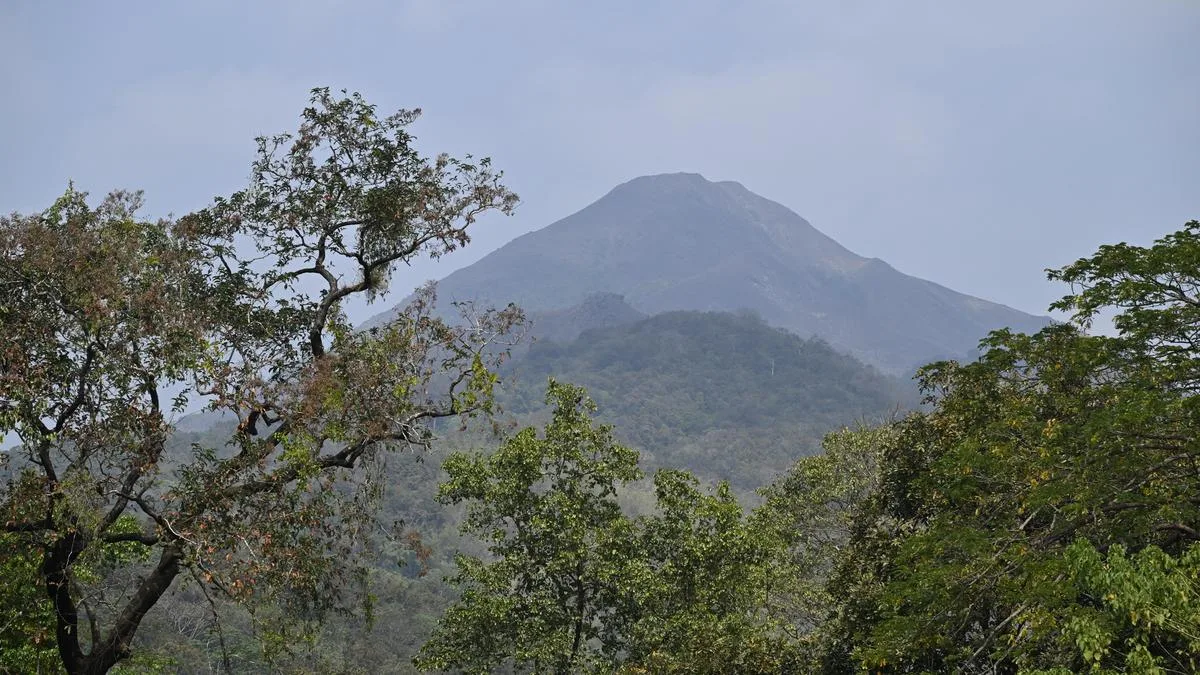
A view of the ecologically-sensitive area of the Western Ghats, near Gundya. | Photo Credit: K. MURALI KUMAR
On August 29, hundreds of farmers from Hosanagara taluk in Shivamogga district marched about nine kilometres from the Ganesha temple at Karanagiri to Hosanagara town, protesting against the latest draft notification proposing to declare large parts of the Western Ghats an Ecologically Sensitive Area (ESA). Farmers across Shivamogga and neighbouring districts in the Malnad region are planning similar protests in the coming days. Their central demand is that the Karnataka government conduct a physical survey of the land and exclude human settlements and cultivated areas from the proposed ESA boundaries.
The chain of events that led to this notification began with another march nearly four decades ago — one that set out to save the Western Ghats.
Also Read: Vande Mataram ends after 2 stanzas in Karnataka Assembly and Council; BJP legislators recite full version
On November 1, 1987, two groups of scientists, ecologists, environmentalists, and activists began walking simultaneously from the northern and southern extremities of the Western Ghats — Navapur in Dhule district, Maharashtra, and Kanyakumari in Tamil Nadu — towards a common meeting point in Goa. Among the organisers and participants were anthropologist Kailash Malhotra, S.R. Hiremath, Pandurang Hegde, and several others from Karnataka. Along the route, participants held public meetings and documented the ecological condition of the landscape. The effort culminated in a conference in Goa in February 1988, where ecologist Madhav Gadgil of the Indian Institute of Science, Bengaluru, chaired the technical session on the region’s ecological status and the measures needed to conserve it.
The group remained active in the years that followed: a yatra marked the march’s 10th anniversary in 1998, and further meetings were held in 2009 and, more significantly, on February 18, 2010, at the Keystone Foundation in Kotagiri, Nilgiris, Tamil Nadu. The organisers invited the then Union Minister for Environment and Forests, Jairam Ramesh, to inaugurate the meeting and appealed to him to constitute an expert panel to examine the status of the Western Ghats and recommend conservation and governance mechanisms.
Hundreds of farmers participated in a protest march opposing the ESA notification in Hosanagara on August 29. | Photo Credit: SPECIAL ARRANGEMENT
Less than a month later, on March 4, 2010, the Ministry of Environment and Forests set up the Western Ghats Ecology Expert Panel (WGEEP) under Prof. Gadgil’s chairmanship, comprising nine non-government and five official members. Its mandate was to assess the ecological status of the Western Ghats, demarcate areas to be notified as ecologically sensitive zones under the Environment (Protection) Act, 1986, and recommend measures for conservation and rejuvenation through wide consultation.
The panel submitted its final report to the Ministry on August 31, 2011 — by which time Mr.
5News aggregated this summary from the outlet’s public feed. The full article, with all the context, is on www.thehindu.com — the content belongs to The Hindu.