With Trump-Xi truce, China looks to reshape Asian order
Account subscription benefits alongside Premium Stories, Editorials, Opinions and more. Unlock these with Subscription
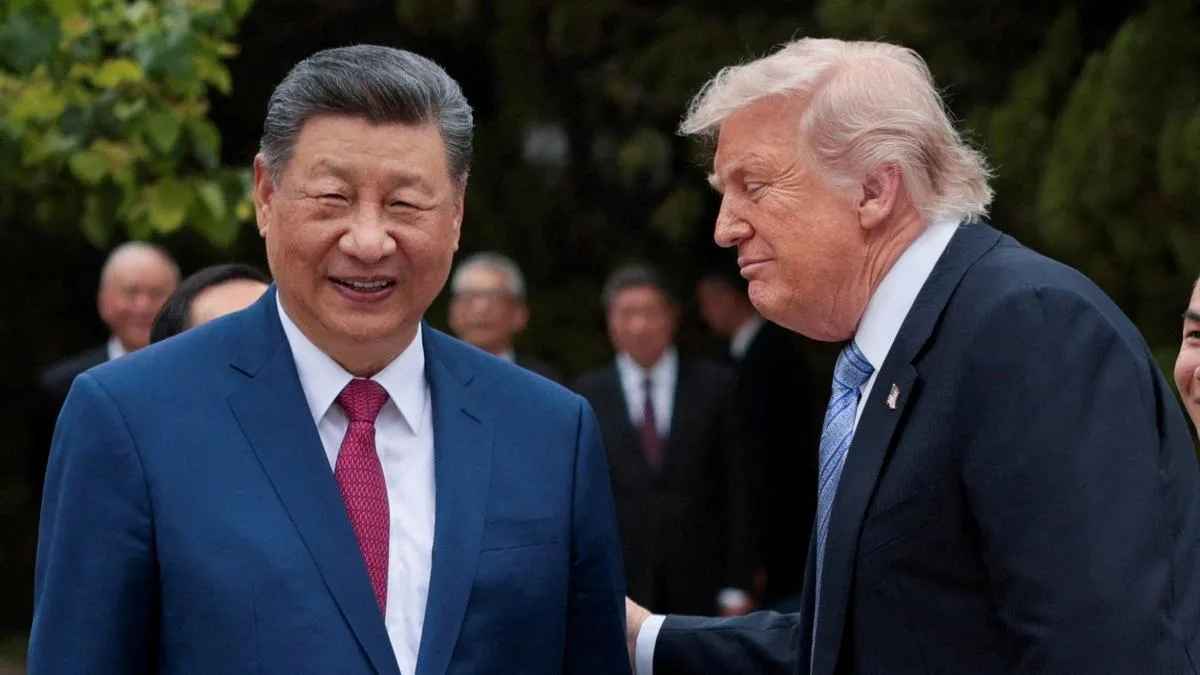
U.S. President Donald Trump speaks with Chinese President Xi Jinping while leaving after a visit to the Zhongnanhai Garden in Beijing, China, May 15, 2026. | Photo Credit: Reuters
As U.S. President Donald Trump hosts Chinese President Xi Jinping at the White House on Thursday (September 23, 2026), the world’s two biggest powers appear to be looking to extend their truce.
In May, when Mr. Trump visited Beijing , both sides declared their commitment to build a “constructive relationship of strategic stability”, a Chinese coinage that the U.S. President, to the surprise of many observers, readily accepted.
Also Read | Trump-Xi Summit in Washington: Key topics of discussion, schedule and more
This week, Mr. Trump is laying the red carpet for Mr. Xi, including by personally welcoming him at Joint Base Andrews, a courtesy he has not extended to any other leader.
Optics aside, the expectations for the visit are, however, largely modest on both sides, seen an effort to put a floor on a contentious relationship rather than a grand bargain. This is regardless of Mr. Trump’s stated fondness for the idea of a “G2” which has concerned countries in the region, including India.
Also Read: Xi arrives in Washington, kicking off his state visit with rare planeside welcome from Trump
In the weeks after Mr. Trump’s visit to Beijing, both sides have traded blows, including the listing of Chinese companies such as Alibaba and BYD by the Pentagon for “civil military fusion”, and mutual accusations over how the other side is conducting the AI race. Other sticking points remain unresolved, such as tariffs, restrictions on semiconductors and Chinese export controls, especially on rare earths. China is also pressing the U.S. to stop arms sales to Taiwan, described by Beijing as the biggest flashpoint in the relationship.
If this has led some observers to suggest this truce is merely a tactical pause while each side works towards reducing their vulnerabilities and building leverage, others argue there are compelling reasons for both powers to pursue a future relationship of stability.
Writing in Foreign Affairs before the visit, Da Wei, a leading voice in Beijing on the China-U.S. relationship and Director of the Center for International Security and Strategy at Tsinghua University, made the case for why despite structural challenges, there were reasons for both to pursue a detente.
“The rapid development of technologies such as AI will make it particularly difficult for either the U.S. or China to eliminate the other’s sources of leverage,” he said. In the lead up to the visit, the two sides held talks in New York between Treasury Secretary Scott Bessent and Chinese Vice Premier He Lifeng, including to set up a dialogue mechanism for AI cooperation.
The broader reason for a continued truce, in the view of Da Wei, was the narrowing power differential between the two countries. “China is looking at bilateral relations from a position of greater equality and with more confidence,” he said.
5News aggregated this summary from the outlet’s public feed. The full article, with all the context, is on www.thehindu.com — the content belongs to The Hindu - International.