NRIs can transfer money from NRO to NRE account, but what is the annual limit? Check details here
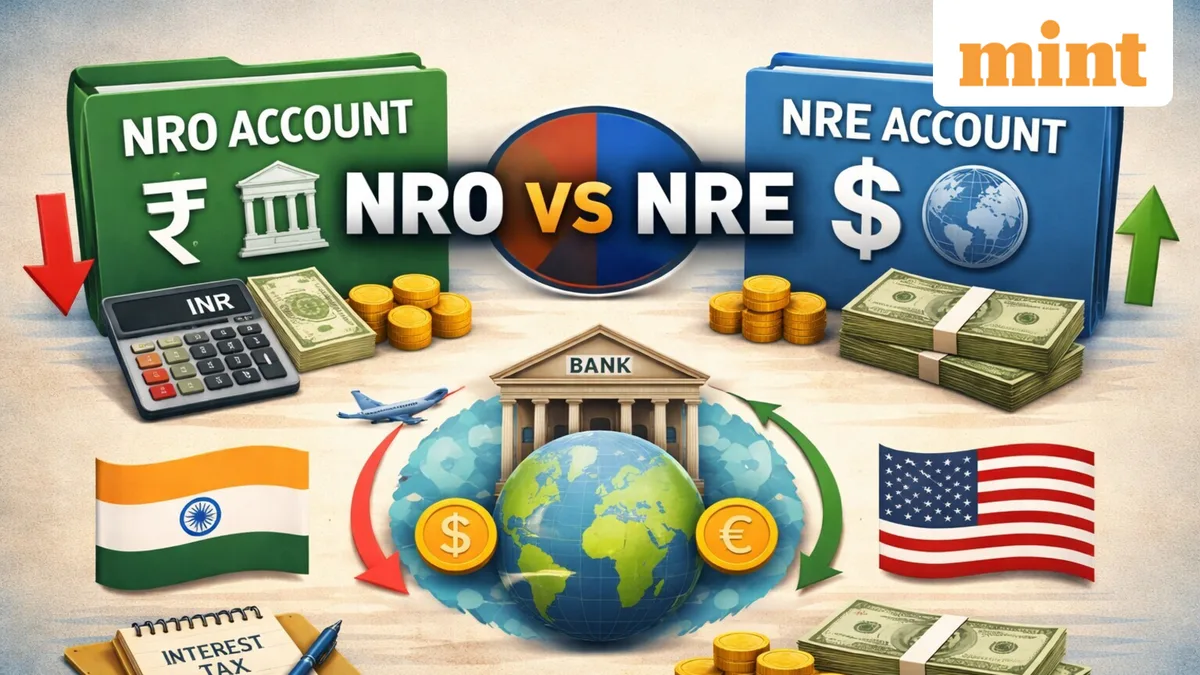
If you are a non-resident Indian (NRI), transferring money between bank accounts in India can be an important part of managing finances across countries. The type of account you use matters, particularly if you plan to remit funds overseas or transfer money to another NRI account.
A NRO (non-resident ordinary) account serves as a convenient way for individuals living abroad to manage income earned in India from sources such as rent, dividends or pension.
Meanwhile, an NRE (non-resident external) account is meant for parking your foreign earnings in India, with an intention of supporting your family staying in the country, making investments, among others.
You cannot transfer money to an NRE account from a savings account in India, but you are allowed to move money from an NRO to an NRE account. A person can also transfer money from one NRE account to another.
Balances held in NRE accounts can be fully repatriated, whereas funds in an NRO account are partially repatriable up to $1 million per financial year, subject to payment of taxes in some cases.
Overseas earnings can be deposited in an NRE account, whereas an NRO receive income from both Indian and overseas sources.
Many NRIs may wonder why they should even think about moving eligible funds from an NRO to an NRE account. Some key benefits include:
NRIs transferring funds from an NRO account may need to keep certain documents and declarations ready to establish the source of funds and demonstrate that applicable taxes have been paid.
These may include Form 145, an online declaration submitted to the Income Tax Department confirming that applicable taxes have been deducted or paid.
Form 146 is a certificate issued by a Chartered Accountant. It validates the nature of the remittance and certifies that the applicable tax has been correctly calculated and paid.
Other documents may include proof establishing the source of funds and a declaration confirming compliance with the relevant provisions of the Foreign Exchange Management Act (FEMA).
Eshita Gain is a digital journalist at Mint, where she joined in May 2025. She writes on corporate developments, personal finance, markets, and business trends, with a focus on delivering timely and relevant stories to a broad audience. <br><br> While her core beat lies in business and finance, she is not confined to a single niche and frequently explores stories across domains, including international relations and policy developments. <br><br> She holds a postgraduate diploma in business and financial journalism by Bloomberg from the Asian College of Journalism (ACJ), Chennai. During her time there, she received rigorous training in tracking financial data, interpreting corporate filings, and reporting on business developments. She has pursued her graduation from St. Joseph’s University, Bengaluru in a multi-disciplinary course. Her majors included Journalism, International Relations, peace and conflict studies. <br><br> Eshita has previously worked in digital marketing, which enables her to write SEO friendly copies that are clear and engaging.
5News aggregated this summary from the outlet’s public feed. The full article, with all the context, is on www.livemint.com — the content belongs to LiveMint - Money.