Iran's decades-long war planning helped it withstand US-Israel strikes
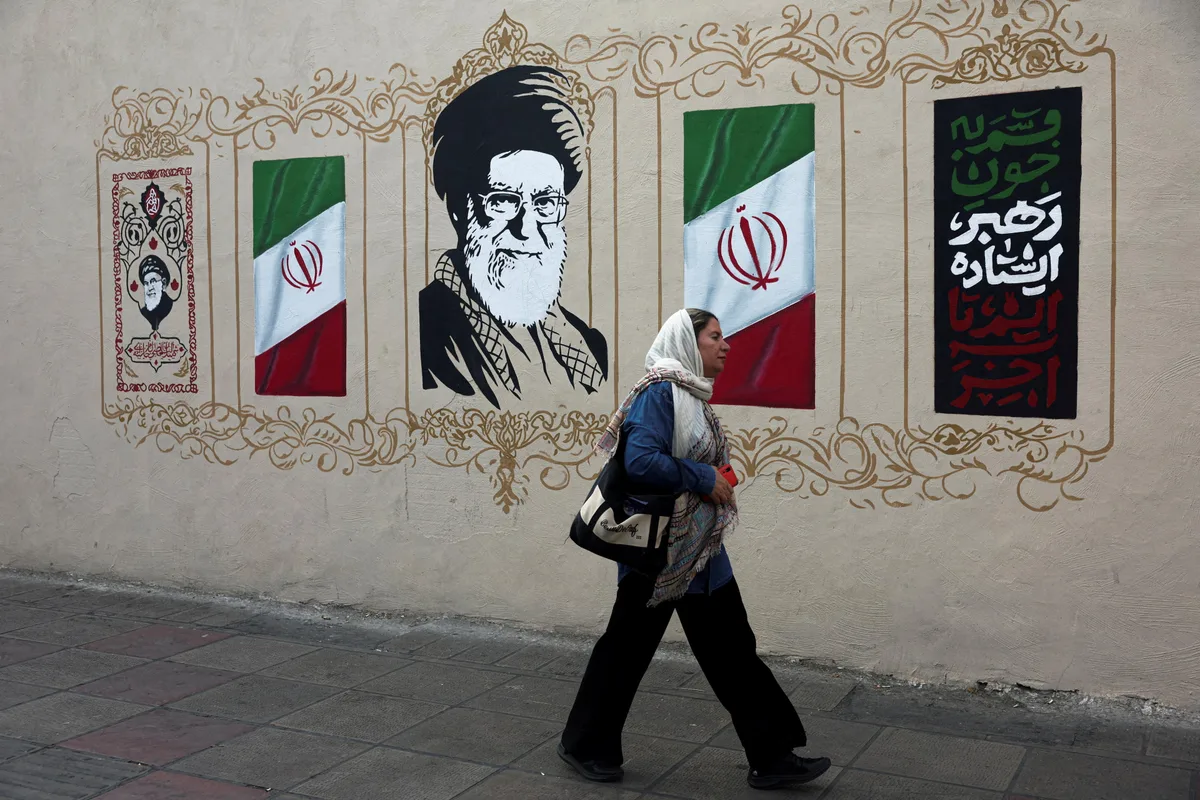
A woman walks by a mural depicting Iran's late Supreme Leader Ayatollah Ali Khamenei, on a street in Tehran, Iran, August 13, 2026 | Image: WANA via Reuters
Iran had prepared for a potential war with the US for four decades, including contingencies such as the loss of its top leadership, making it difficult for its adversaries to decimate the country, an Indian military expert has said.
Speaking at an interactive session in Washington organised by Observer Research Foundation (ORF) America on Friday, retired Indian Army officer Lt General KJS Dhillon said Iran had retained the capability for "attritional warfare" despite suffering heavy losses in the conflict with the US and Israel.
Dhillon, who previously served as the head of India's defence intelligence agency, said one of the key lessons from the war was the need for a clearly defined national aim and a well-planned exit strategy.
"Before you initiate a war, knowing a few things beforehand are a must. Your declared national aim should be clear to yourself, your military and the people in the government. There should also be clarity on the end stage where one can declare victory," he said.
"... then the exit strategy, especially if it's an overseas war. How do I get out of that area?" he said, adding that countries going to war must also plan for and control the escalation, particularly when confronting powers such as the US and Israel together.
Dhillon said Iran had fought the war broadly along lines it had envisaged over the past 40 years, including preparing for the possible loss of its top leadership.
He said Iran had adopted a "mosaic doctrine" and decentralised its armed forces into 31 independent headquarters that could continue functioning even if the central leadership was destroyed.
Iran has also retained the capability to wage attritional warfare, which can favour a weaker side in a prolonged conflict, he said.
The retired officer said Iran's mountainous terrain made a ground invasion difficult for its adversaries, unlike the relatively open deserts of Iraq and Saudi Arabia.
"Iran is a mountainous bowl all around with the desert inside where the temperatures go up to 55, 60 degrees centigrade in summers," he said.
"To get into the heart of Iran you have to cross those mountains. You have to literally capture each and every picket, so boots on the ground were a no-go," Dhillon said.
Iran does not have aircraft carriers or a strong air force to directly challenge the US on the high seas, he said, adding that it instead developed capabilities suited to defending the Strait of Hormuz.
Dhillon said Iran had adopted a strategy centred on chokepoints, using speed boats, sea mines, torpedo boats, coastal guns, missiles and drones, supported by a navy designed primarily for the defence of the strategic waterway.
5News aggregated this summary from the outlet’s public feed. The full article, with all the context, is on www.business-standard.com — the content belongs to Business Standard.