₹10,000 per month in PPF or SIP? Which builds more wealth in 15 years - A comparison of post-tax return
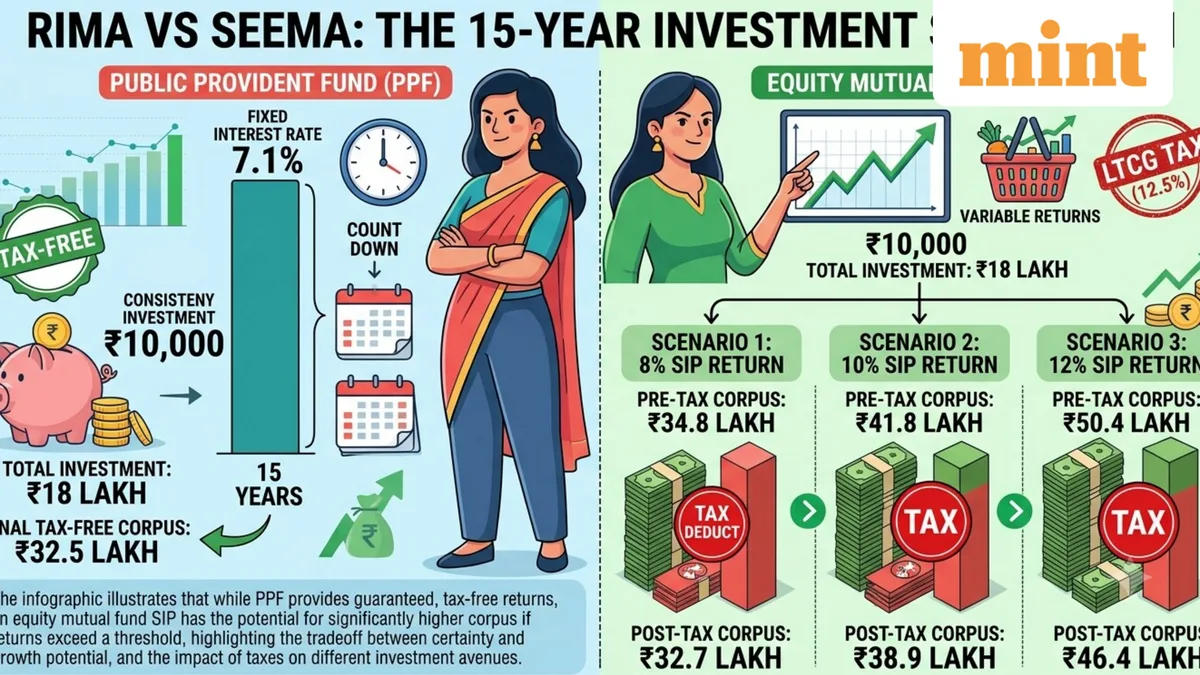
Rima and Seema want to create a sizeable corpus over the next 15 years, and both can set aside ₹ 10,000 every month for their goal. But they choose different ways to invest – Rima chooses the Public Provident Fund (PPF), Seema opts for an equity mutual fund through SIP. But who ends up with more money?
While making any investment, how much money you end up with depends on two main factors: the return generated and the current interest rate. For an equity mutual fund, the return is not fixed, plus the investor has to pay an LTCG. Meanwhile, PPF currently offers an interest rate of 7.1%. The interest earned is exempt from income tax. Here's a look at how both options work:
If Rima invests ₹ 10,000 every month, then at the end of 15 years, her total investment will be ₹ 18 lakh. Considering the PPF interest rate remains at 7.1% throughout 15 years, she would be able to create a corpus of roughly ₹ 32.5 lakh at maturity. As PPF maturity proceeds are tax-free, the entire amount remains with her.
Seema, meanwhile, puts the same ₹ 18 lakh into an equity mutual fund SIP, and her final corpus will depend on market returns. Let's look at three examples to understand this.
First, let's assume that her SIP earns 8% annually, and that way, the corpus could grow to around ₹ 34.8 lakh before tax. After accounting for long-term capital gains tax of 12.5%, her post-tax corpus would be about ₹ 32.7 lakh.
In the second case, if her SIP earns 10% annually, Seema would end up with a corpus of ₹ 41.8 lakh. And after paying her taxes, she would be left with roughly ₹ 38.9 lakh.
And if the SIP delivers 12% annually, the corpus could reach nearly ₹ 50.4 lakh before tax. After tax, Seema could have around ₹ 46.4 lakh.
The comparison points out something very interesting. When the returns were at 8%, the post-tax advantage over PPF is almost negligible. The gap widens significantly when the SIP earns 10% or 12%.
However, the two investments can not be compared directly; PPF provides predictable returns and capital protection, on the other hand, equity SIP returns are market-linked and can fluctuate sharply.
For Rima, PPF may therefore be about certainty and tax-free wealth creation. For Seema, the SIP offers the possibility of significantly higher wealth — but only if she can tolerate market volatility and stay invested for the long term.
Sanchari Ghosh is an Assistant Editor at Mint with over 12 years of experience in journalism, specialising in personal finance, DLT & DeFi, geopolitics and foreign policy, with a particular emphasis on how these areas intersect. <br> She writes extensively about how money works in everyday life—helping readers navigate personal finance decisions. <br> As AI reshapes investing behaviour, capital is increasingly flowing into decentralized ecosystems, redefining how assets are managed, traded, and valued. She focuses on explaining how money flows within frameworks like Distributed Ledger Technology (DLT), DeFi protocols, and crypto markets—while also exploring what the future of money could look like in a trustless, programmable financial world.
5News aggregated this summary from the outlet’s public feed. The full article, with all the context, is on www.livemint.com — the content belongs to LiveMint - Money.