Navaratri notes: How Syama Sastri’s iconic swarajatis are an intimate dialogue with the goddess
Account subscription benefits alongside Premium Stories, Editorials, Opinions and more. Unlock these with Subscription
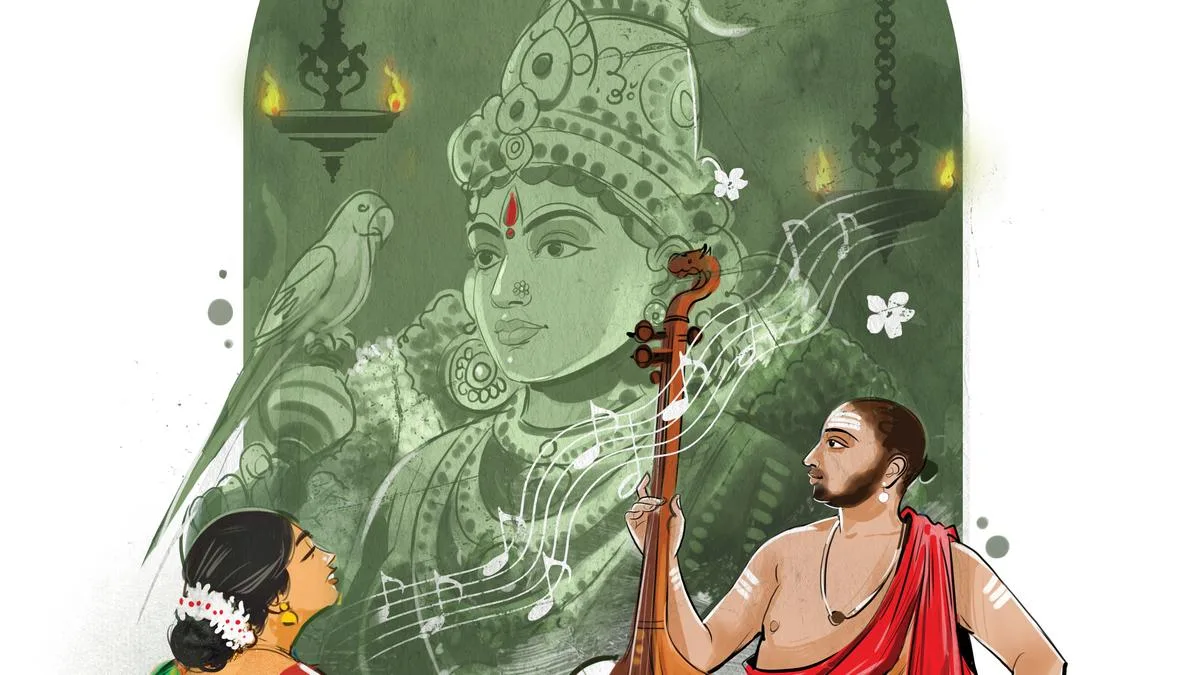
Syama Sastri’s compositions describe Kamakshi’s beauty, majesty and glory, while addressing her as a child would address his mother. | Photo Credit: Illustration: SAAI
Syama Sastri belonged to a family of hereditary archakas at the Kamakshi Temple in Kanchipuram. During a period of political turmoil, his ancestors left Kanchipuram, carrying with them the golden vigraha of Kamakshi (Bangaru Kamakshi). They travelled through several places before finally settling in Thanjavur. It was during this period of migration that Syama Sastri was born in Tiruvarur. He later made Thanjavur his home, living beside the Kamakshi temple and regularly performing puja to the goddess.
Kanchipuram occupies a cherished place in India’s cultural, spiritual, philosophical, historical and religious heritage. Its sacred temples, particularly the shrine of Kamakshi, have inspired generations of poets, saints and composers. The Trinity have celebrated the goddess through their music, dedicating many compositions to Her. Tyagaraja’s ‘Vinayakuni valenu brovave’, and Dikshitar’s ‘Nirajakshi Kamakshi’, ‘Kanjadalayatakshi’, ‘Kamakshi Varalakshmi’ and several other compositions are among the well-known works dedicated to the goddess.
With the exception of a few kritis, all of Syama Sastri’s compositions are dedicated to Kamakshi. While each is a precious gem, the three swarajatis — ’Kamakshi Anudinamu’ (Bhairavi), ’Rave Himagiri Kumari’ (Thodi) and ’Kamakshi Ni Pada’ (Yadukula Kamboji) — occupy a special place in his oeuvre.
These works are marked by his musical genius and intense devotion to the deity. In the swarajatis, Syama Sastri describes Kamakshi’s beauty, majesty and glory, while addressing her as a child would address his mother. This mother–child sentiment is reflected in the simple, direct and deeply personal Telugu sahitya. The verses draw the listener into the intimate world of a devotee.
While a profound sense of surrender runs through all three compositions, the Bhairavi and Yadukula Kamboji swarajatis express it in the opening lines of the pallavi:
“O Kamakshi, every day, without forgetting, I place my trust in Your feet as my only refuge.”
‘Kamakshi ni pada yugamu sthiramani ne nammi unnanu, na cintalellanu dircamma’
“I have placed my steadfast trust in Your feet; please dispel all my worries, Mother.”
In the Pallavi of ‘Rave Himagiri Kumari’, he makes a supplication to his Mother and asks Her to confer him with boons; sentiment of surrender appears later:
He offers an inkling of this spirit of surrender even in his first composition, Janani Natajana Paripalini, through the repeated words “nammiti, nammiti, nammiti”, “I place my trust entirely in You.”
Swarajati, as the name suggests, combines swara and jati. Syama Sastri’s swarajatis, however, are structured differently.
5News aggregated this summary from the outlet’s public feed. The full article, with all the context, is on www.thehindu.com — the content belongs to The Hindu - Entertainment.