2026 Nobel medicine prize: Trio wins for optogenetics work
Account subscription benefits alongside Premium Stories, Editorials, Opinions and more. Unlock these with Subscription
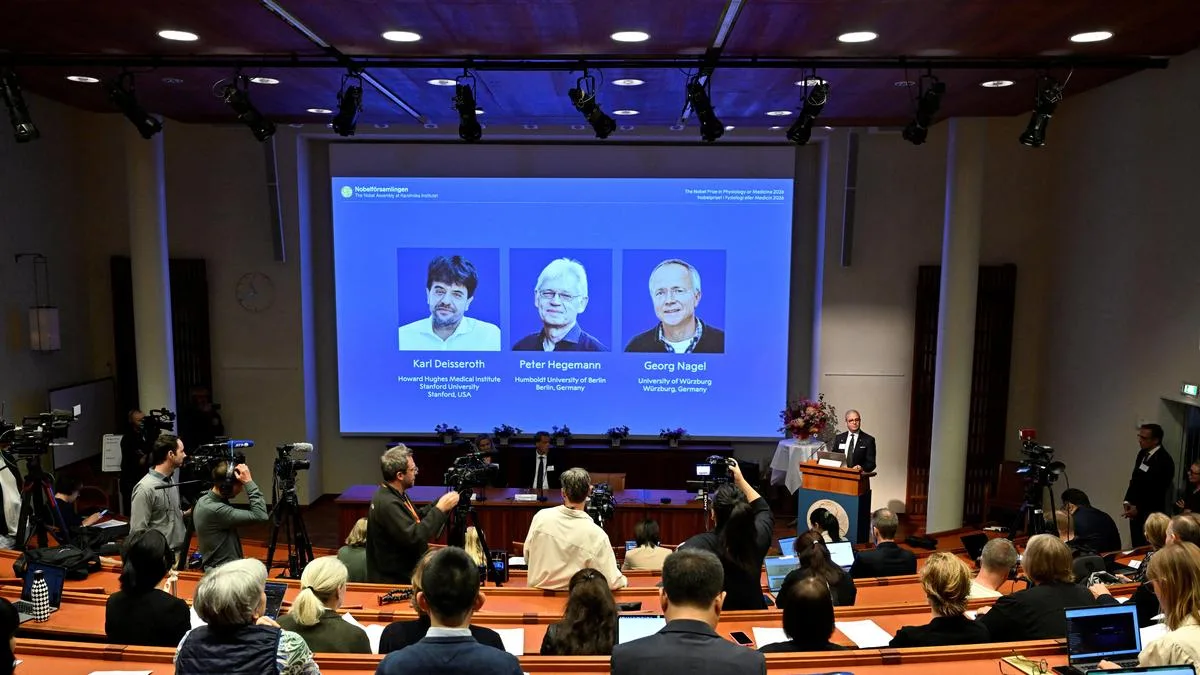
Karl Deisseroth, Peter Hegemann and Georg Nagel are awarded the 2026 Nobel Prize in Physiology or Medicine, as announced during a press conference at the Nobel Forum at Karolinska Institute in Stockholm, Sweden, October 5, 2026. | Photo Credit: TT News Agency/Pontus Lundahl/via Reuters
A trio of scientists has been awarded the 2026 Nobel Prize in Physiology or Medicine for discoveries leading to a technique called optogenetics, which allows scientists to control select nerve cells using light.
The Nobel Assembly said the work of the laureates — Karl Deisseroth, Peter Hegemann, and Georg Nagel — allowed neuroscience to move beyond observing correlations and testing how particular neurons and neural circuits are related to different behaviours and emotions. Today, optogenetics helps scientists study schizophrenia, depression, Alzheimer’s and Parkinson’s diseases, and test treatments to restore vision and hearing loss.
The laureates will share the prize, worth 12 million Swedish kronor (₹11.5 crore), equally.
In the 1990s, Mr. Hegemann, now at Humboldt University in Berlin, and his team found that shining light on a microscopic alga called Chlamydomonas rapidly triggered an electric signal within its body. He reasoned that the molecule involved in detecting light might be, or linked to, a protein that lets certain charged ions enter cells.
Around 2000, Mr. Hegemann approached Mr. Nagel, who confirmed the idea in an experiment. The team identified two proteins that were channels, and they opened when exposed to light. The scientists called them channelrhodopsin-1 and channelrhodopsin-2. Channelrhodopsin-2 in particular opened within 0.2 ms when light was shone on it, allowing positively charged ions to flow into a cell and produce an electric signal. Mr. Hegemann and Mr. Nagel showed that putting the gene for this protein in mammal cells also made them sensitive to light.
At Stanford University, Mr. Deisseroth realised this discovery could transform the way scientists study the brain. Genetic methods could make sure the protein was associated with a specific set of neurons, while light could turn those neurons on or off. This level of control offered greater precision than previous methods such as drugs and electrical stimulation.
His encounters in the clinic with people with depression and schizophrenia had also convinced him that it was important for scientists to study how certain neurons worked inside certain circuits to understand these conditions.
His team published its first major result in 2005 using rat neurons, and a year later, the technique had its name: optogenetics. In 2007, Mr. Deisseroth’s group stimulated specific neurons in the brain of live mice with light sent through a slender fibre-optic cable, moving the mice’s whiskers.
Since then, scientists have used optogenetics to identify networks in the brain involved in pain, attention, sleep, memories, and social behaviours.
5News aggregated this summary from the outlet’s public feed. The full article, with all the context, is on www.thehindu.com — the content belongs to The Hindu - Sci-Tech.