Mid-cap vs small-cap funds: What alpha reveals about their performance – Taurus Mid Cap Fund among top laggards
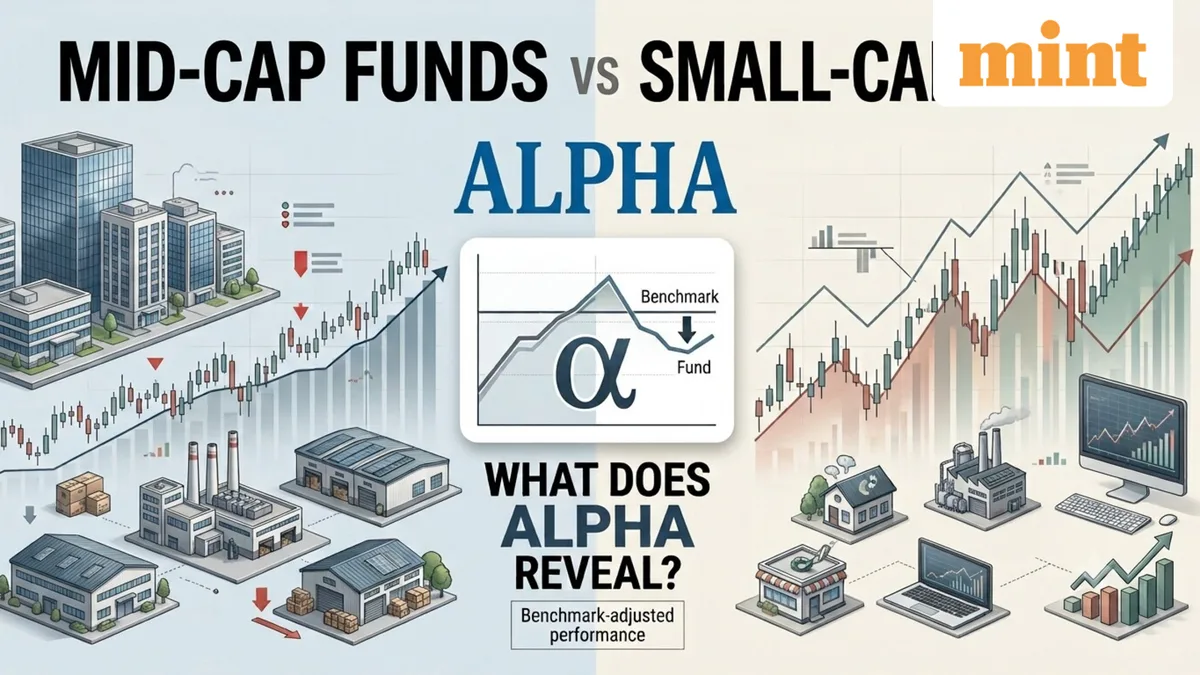
Mid-cap and small-cap funds are equity mutual fund categories that invest predominantly in their respective market-cap segments. Under SEBI’s categorisation framework, both categories must invest at least 65% of their total assets in mid-cap or small-cap stocks, respectively.
Mid-cap stocks are generally considered less volatile than small-cap stocks, while small-cap stocks can offer higher growth potential but also come with greater risk. However, returns are not the only way to assess how a fund has performed against its benchmark. Alpha provides another important measure.
According to the latest AMFI July 2026 data, there are a total of 33 mid-cap funds and 36 small-cap funds.
According to Value Research data, three mid-cap funds stand out for having the most negative alpha.
*Source: Value Research, Direct plans, Data as on 31 July 2026, Alpha have been calculated using calendar month returns for the last three years.
Taurus Mid Cap Fund had the most negative alpha at -5.38, indicating the largest underperformance against its benchmark in the category. UTI Mid Cap Fund and PGIM India Midcap Opportunities Fund followed with negative alphas of 3.33 and 3.24, respectively.
A negative alpha does not necessarily mean the fund delivered a negative return. It means the fund underperformed its benchmark after adjusting for market risk.
For example, if a mid-cap fund’s benchmark delivered a 20% return while the fund generated 14.62%, its alpha would be -5.38%. This means the fund underperformed its benchmark by 5.38 percentage points after adjusting for market risk.
*Source: Value Research, Direct plans, Data as on 31 July 2026, Alpha have been calculated using calendar month returns for the last three years.
Tata Small Cap Fund recorded the lowest alpha at -1.70, followed by SBI Small Cap Fund at -1.20 and Kotak Small Cap Fund at -0.72.
Compared with the three mid-cap funds above, the negative alpha figures for these small-cap funds are less pronounced. This suggests that their underperformance relative to benchmarks was comparatively smaller.
According to Value Research , the category average alpha for mid-cap funds is 1.15%, while the average alpha for small-cap funds is 2.89%.
A higher category-average alpha indicates that funds in the small-cap category generated more excess return over their benchmarks after adjusting for market risk than mid-cap funds during the period measured.
However, category averages can hide significant differences between individual schemes. As the fund-level data shows, some funds in both categories recorded negative alpha.
5News aggregated this summary from the outlet’s public feed. The full article, with all the context, is on www.livemint.com — the content belongs to LiveMint - Money.