Puducherry’s Bahour lake shrinks amid encroachments, clogged feeder channels
Account subscription benefits alongside Premium Stories, Editorials, Opinions and more. Unlock these with Subscription
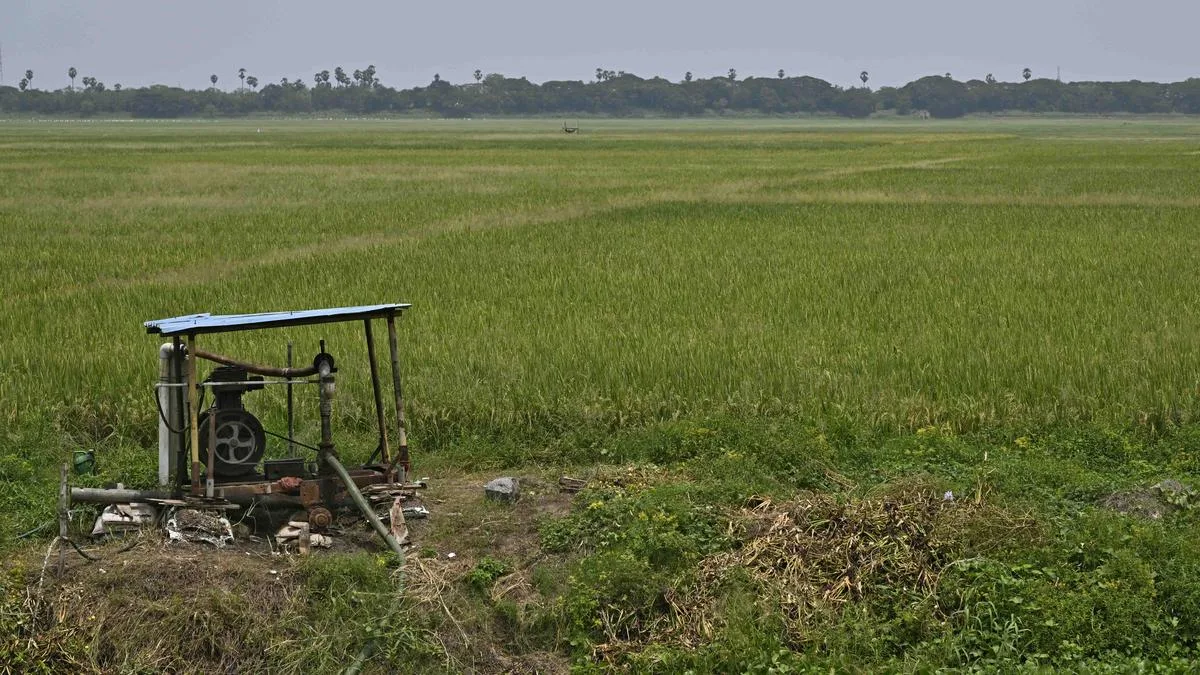
A motor pump being used to illegally draw water to irrigate the paddy crops raised on the Bahour Lake in Puducherry | Photo Credit: S.S. Kumar
Bahour Lake, Puducherry’s second-largest freshwater lake and an important irrigation source, is gradually losing its water-spread area because of unchecked cultivation, encroachments and poorly maintained feeder channels, according to farmers and environmental activists.
Spread over 1,765 acres, the lake has been shrinking over the years due to human interventions, including agricultural activity within its water-spread area and the issue of pattas by the Revenue Departments of Puducherry and Tamil Nadu, they said. Small bunds, pathways and other alterations have reportedly been created to facilitate cultivation.
The lake, believed to predate the Chola period, was deepened during the reign of the Cholas. It is fed by the Bangaru Vaikal, which branches off from the Sornavur Anaicut on the Thenpennaiar river, around 16.8 km away. The channel has a surplus weir, while a portion of the tank, including its bund, falls in neighbouring Cuddalore district of Tamil Nadu.
Legend has it that on hearing that famine was prevalent in those days in the area, Bangari, a dancer in the area, constructed the canal at her expense while her sister Singari bore the expenses to raise the bunds. In the 1970s, the tank served an ayacut of 1,740 acres — 1,689 acres in Puducherry and 76 acres in Tamil Nadu.
V. Chandrasekhar, president of the Bangaru Vaickal Neeraadhara Kootamaippu, a farmers’ collective and water users’ association, said the lake had nearly dried up because of poor maintenance of the feeder channels and the absence of desilting work for decades.
A channel of the Bahour lake covered with thick vegetation due to lack of desilting | Photo Credit: S.S. Kumar
“The lake has not been properly desilted since 1980. Water hyacinth has spread across the northern stretches of the canal, while water is being diverted to irrigate crops grown in the lake area. The point where the canal joins the lake has also been encroached upon at several places,” he said.
Mr. Chandrasekhar alleged that the Revenue Departments of Puducherry and Tamil Nadu had issued pattas within the lake’s water-spread area, enabling 136 persons to cultivate single- and multi-season crops.
“Cultivation in the lakebed could reduce its capacity to store monsoon rainwater and affect groundwater recharge in surrounding areas. Feeder channels intended to carry runoff into the lake had become clogged with weeds, silt and overgrown vegetation. A dry lakebed remains part of the waterbody. It cannot be treated as private agricultural land,” an environmentalist said.
Standing paddy crops raised on the water expanse area of the Bahour Lake in Puducherry | Photo Credit: S.S. Kumar
Sivakumar, a farmer from Karaimedu, said encroachments had already caused the lake to lose its identity. Illegal fishing had further worsened the situation, he alleged.
5News aggregated this summary from the outlet’s public feed. The full article, with all the context, is on www.thehindu.com — the content belongs to The Hindu.