Why was the former President of Kosovo convicted by The Hague? Explained
Account subscription benefits alongside Premium Stories, Editorials, Opinions and more. Unlock these with Subscription
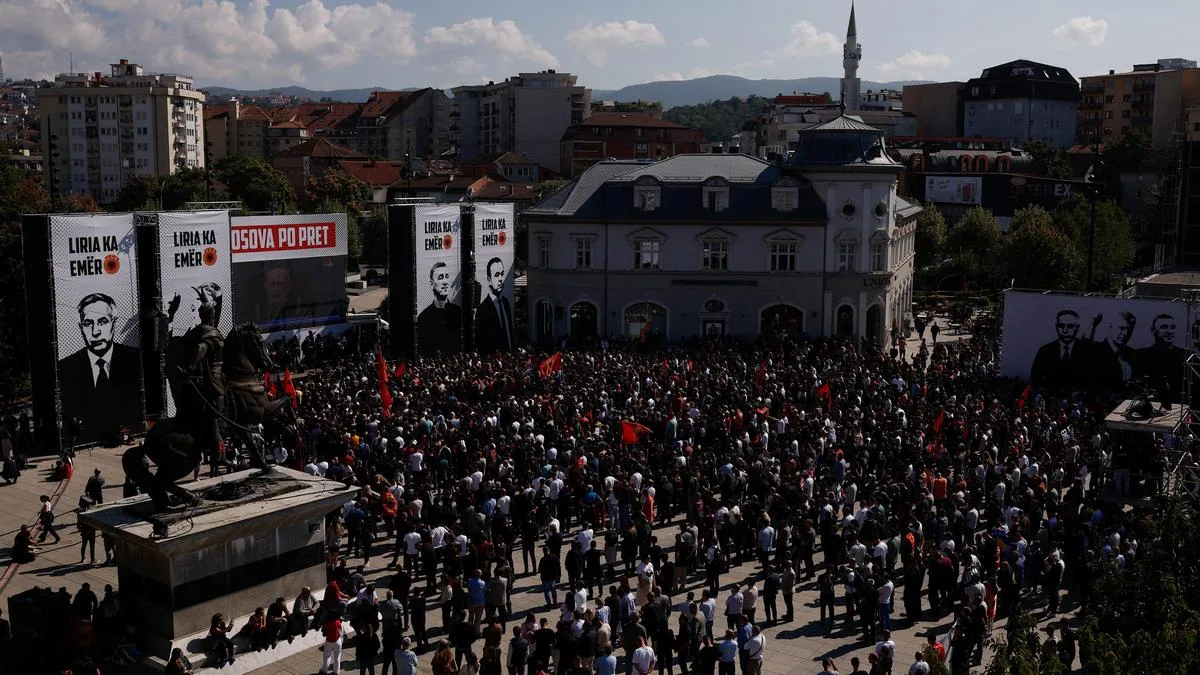
Supporters of former Kosovo President Hashim Thaci gather on the day he and other former Kosovo Liberation Army (KLA) members hear the judgment in their war crimes trial at the Kosovo Specialist Chambers in The Hague, in Pristina, Kosovo, on September 16, 2026. | Photo Credit: Reuters
The story so far: Hashim Thaci, the former President of Kosovo, has been sentenced to 25 years in prison after being found guilty of war crimes by a special European Union-backed court at The Hague. The trial found him guilty of crimes including murder, arbitrary detention, illegal arrests, torture etc during the Kosovo war in the late 1990s as a senior commandant of the Kosovo Liberation Army (KLA). Three other former KLA commanders were also sentenced for several different charges.
Thaci was a former commandant of the KLA, a militant ethnic Albanian force, formed in the early 1990s, which strove for the independence of Kosovo, composed primarily of ethnic Albanians, from Yugoslavia and Serbia.
Kosovo was once part of the erstwhile Republic of Yugoslavia. Post the Second World War, the Kingdom of Yugoslavia was reconstituted as the Socialist Federal Republic of Yugoslavia under the leadership of Josip Broz Tito. While Tito was able to unify the multiple republics, which included Croatia, Montenegro, Serbia, Slovenia, Bosnia and Herzegovina, and Macedonia, and the autonomous provinces of Kosovo and and Vojvodina, under a centralised government, following his death, this centralised system started coming under pressure. Multiple factors such as divisions between the republics, rising nationalist movements, economic pressure, the disintegration of the Soviet Union all contributed to the eventual dissolution of Yugoslavia in 2003.
One of the primary nationalist trends which spearheaded the Yugoslavian dissolution was the Serbian nationalist movement led by Slobodan Milošević in the late 1980s. Riding on Serbian nationalist tendencies, Milošević pushed through policies which stripped other Republics and provinces such as Kosovo of their autonomy. He also brought in policies which were discriminatory in nature against Albanians.
The KLA was first formed in such an atmosphere, in order to fight for the independence of ethnic Albanians in Kosovo, then a province within Serbia. There was an insurgency against the Yugoslavian state within Kosovo, spearheaded by the KLA which attacked Serbian governmental buildings and police stations. This eventually led to all-out war in 1998-1999 with the Serbian controlled federal republic brutally cracking down on the KLA. The war led to the displacement of thousands of people and the death of nearly 13,000 people, mostly ethnic Albanians. The war finally ended with the intervention of NATO (the North Atlantic Treaty Organization) which carried out air raids and bombardments against Serbian targets which forced the federal republic to end hostilities and move out of Kosovo.
5News aggregated this summary from the outlet’s public feed. The full article, with all the context, is on www.thehindu.com — the content belongs to The Hindu - International.