UPI MDR explained: Flat ₹5, 0.40% or 0.02%? Know what applies to merchants, key sectors and capital markets
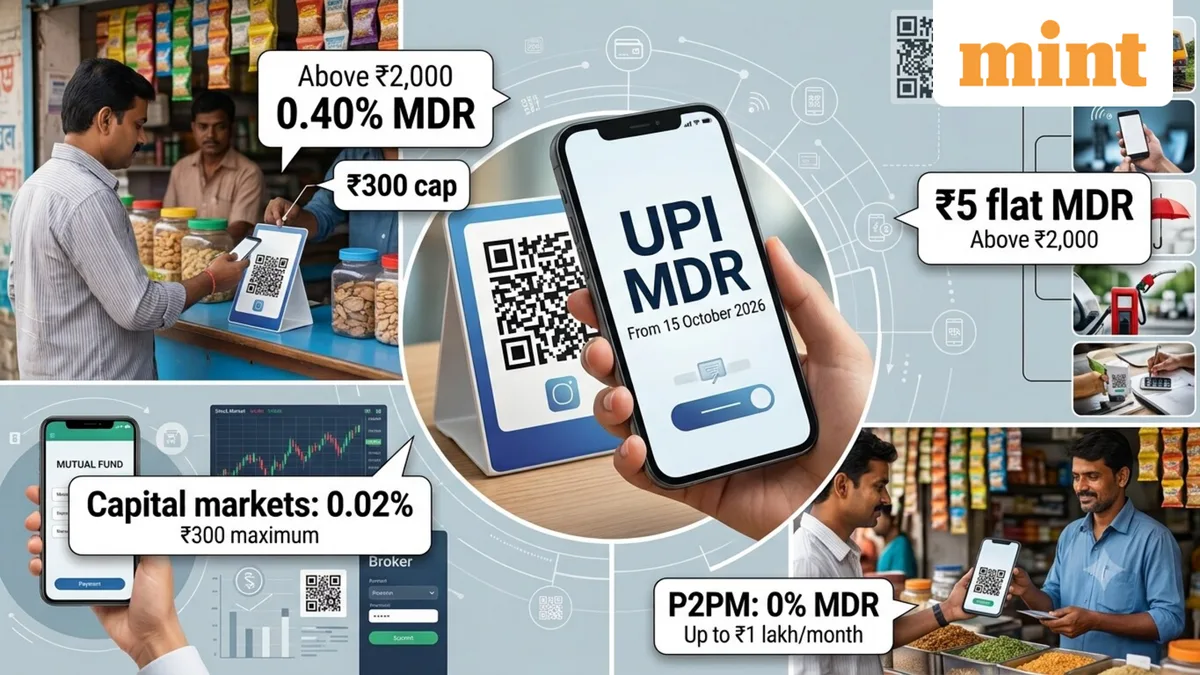
The UPI Merchant Discount Rate (MDR) framework will take effect from 15 October 2026, with a 0.40% MDR applying to Person-to-Merchant (P2M) UPI transactions above ₹ 2,000 for standard merchants.
However, the rate varies based on the transaction value, merchant category, and type of payment.
According to a Motilal Oswal Financial Services’ Morning India report released on Thursday, UPI processed ₹ 29.82 lakh crore worth of transactions in August 2026. P2P transactions accounted for 30% of the total value, while P2M transactions made up the remaining 70%.
MDR is a fee charged for accepting digital payments and is paid by the merchant, not directly by the consumer. Here's what you need to know.
P2P or person-to-person transactions are payments made between individuals, such as sending money to a family member or friend. P2M, or person-to-merchant, transactions are payments made by a customer to a shop, service provider, or other merchant.
P2P UPI transactions have zero MDR irrespective of the transaction amount. For standard P2M transactions, payments up to ₹ 2,000 also have zero MDR, while higher-value transactions will attract MDR of 0.40%.
However, there is a further threshold at ₹ 75,000. Transactions between above ₹ 2,000 and below ₹ 75,000 have no separate cap, while transactions of ₹ 75,000 or more are subject to a maximum MDR of ₹ 300.
In simple terms, the 0.40% rate does not mean the MDR can keep increasing indefinitely for high-value payments. Once a transaction reaches ₹ 75,000, the ₹ 300 cap applies.
Certain sectors, including railways , telecom, insurance, and fuel, will attract a flat MDR of ₹ 5 on transactions above ₹ 2,000.
For example, on a ₹ 10,000 payment, a standard P2M transaction, such as a payment at a shop, would attract ₹ 40 in MDR at 0.40%. In contrast, payments in specified special-rate sectors would attract a flat MDR of ₹ 5, irrespective of the transaction amount.
Capital market -related UPI payments have a separate 0.02% MDR, subject to a maximum cap of ₹ 300. This covers mutual fund payments, securities transactions, stockbroker payments, and dealer payments.
At ₹ 10,000, 0.02% works out to ₹ 2, while at ₹ 1 lakh it works out to ₹ 20. The ₹ 300 cap means the MDR cannot exceed ₹ 300 even when the transaction value is much higher.
The P2PM (Person-to-Person-Merchant) framework is designed to protect micro and small merchants from MDR. It is a specialised category created by NPCI to support small vendors who receive UPI payments directly into their personal bank accounts.
The ₹ 2,000 transaction threshold for standard P2M merchants does not apply in the same way to eligible P2PM merchants.
5News aggregated this summary from the outlet’s public feed. The full article, with all the context, is on www.livemint.com — the content belongs to LiveMint - Money.