Gold vs Nifty 50: What would ₹1 lakh invested 20 years ago be worth today? Check post-tax returns
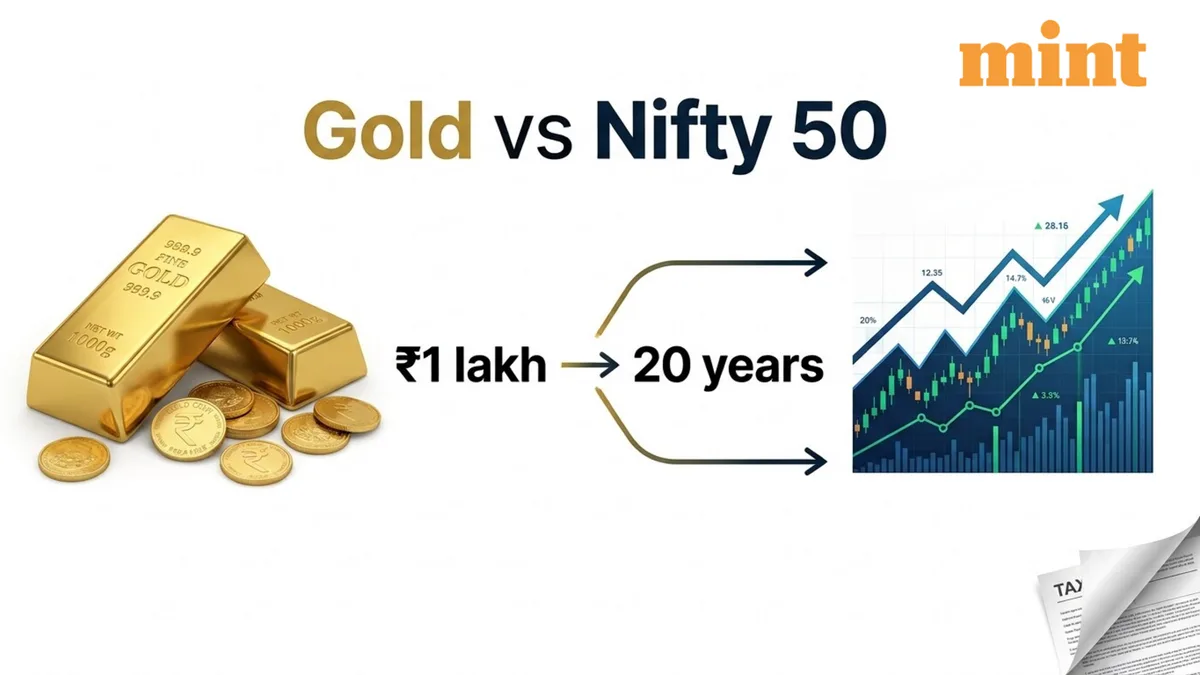
Gold has delivered a higher return than the Nifty 50 over the past 20 years. But for investors, the amount they ultimately take home depends not just on how much the investment has grown, but also on the capital gains tax applicable when it is sold.
Suppose an investor had invested a lump sum of ₹ 1 lakh in both asset classes 20 years ago and held both investments until today.
*Source: FundsIndia’s Wealth Conversations Report, Data as on 31 August 2026, Gold returns are adjusted for USD-INR Exchange Rate
Based on the 20-year annualised returns, the investment would have grown to:
The Nifty 50 ETF is treated as an equity-oriented product for capital gains taxation. If held for more than one year, the gain is generally treated as long-term capital gain (LTCG).
Equity LTCG of up to ₹ 1.25 lakh in a financial year is exempt. Gains above this threshold are taxed at 12.5%, subject to the applicable rules.
For a gold ETF, the equity LTCG exemption does not apply. Long-term gains after one year of holding are taxed at 12.5%.
Here, gold and Nifty 50 TRI returns are used as proxies for the respective ETFs, assuming the ETFs were available for investment 20 years ago.
*Investment Period: 20 years; Excludes surcharge and cess; Actual calculation may vary; Gold and Nifty 50 TRI returns are used as proxies for the respective ETFs, assuming the ETFs were available for investment 20 years ago.
For the Nifty 50 ETF, the ₹ 1 lakh investment grows to about ₹ 8.98 lakh over 20 years, resulting in a capital gain of roughly ₹ 7.98 lakh.
After applying the ₹ 1.25 lakh equity LTCG exemption, the taxable gain comes to about ₹ 6.73 lakh. At 12.5%, the estimated tax is around ₹ 84,000, leaving the investor with ₹ 8.14 lakh after tax.
In a gold ETF, the entire long-term gain is considered for tax at 12.5%. The resulting tax is about ₹ 1.75 lakh, leaving the investor with around ₹ 13.25 lakh after tax.
Once the tax outgo is factored in, the annualised returns are lower than the headline pre-tax CAGR:
The comparison is based on Nifty 50 TRI and gold returns, not the actual returns of any particular ETF. An investor's actual ETF returns can differ because of factors such as expense ratios and tracking error.
5News aggregated this summary from the outlet’s public feed. The full article, with all the context, is on www.livemint.com — the content belongs to LiveMint - Money.