Why stubble fires keep coming back
Account subscription benefits alongside Premium Stories, Editorials, Opinions and more. Unlock these with Subscription
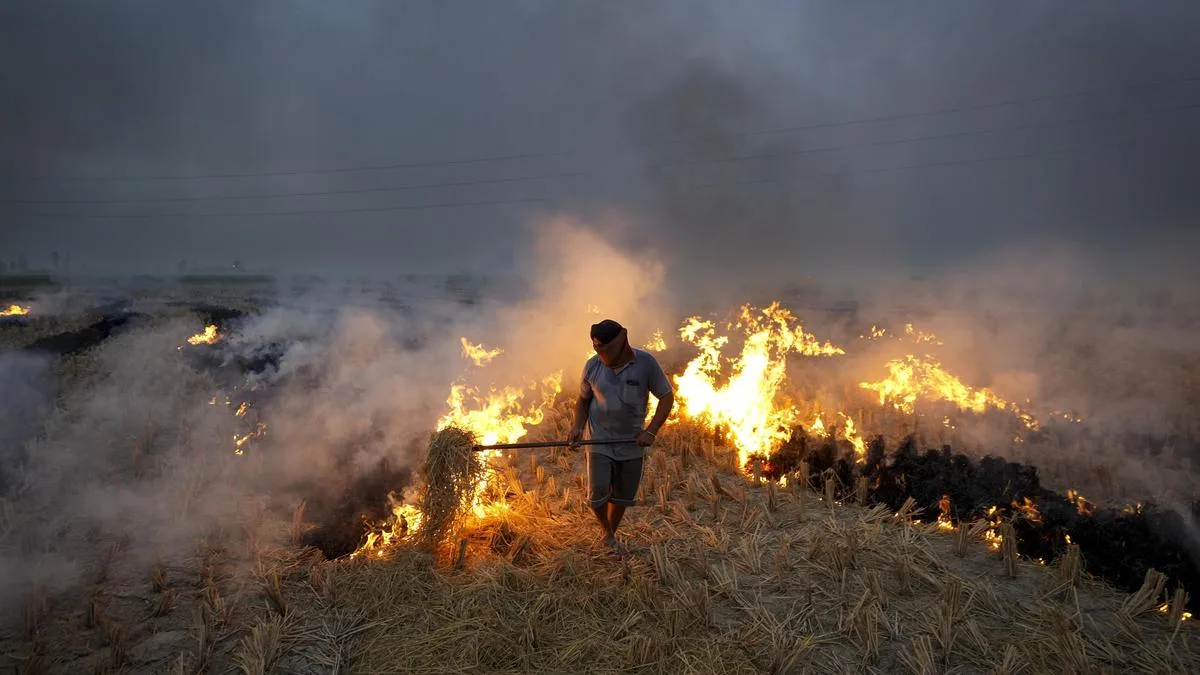
A farmer burns paddy stubble in a field on the outskirts of Amritsar, Punjab | Photo Credit: PTI
I t is that time of the year when air pollution in North India, and in Delhi in particular, takes centre stage in public discourse. One oft-cited reason for the worsening air quality index (AQI) is stubble burning by farmers.
Stubble burning is the practice of setting fire to crop residue, consisting of the lower parts of plants left after harvesting. This practice is prevalent from the beginning of October to the end of November across northwest India, especially in Punjab, Haryana, and parts of Uttar Pradesh. Stubble burning is mainly associated with the burning of paddy straw in Punjab and Haryana, which together produce around 29 million metric tons of paddy straw. Stubble burning releases large amounts of particulate matter, carbon monoxide, volatile organic compounds (VOCs), and other carcinogenic substances, which together form a thick smog that can harm human health. It also leads to a loss of soil fertility by depleting nitrogen, sulphur, potash, phosphorus, and other micronutrients. The heat generated by stubble burning results in a loss of soil moisture and organic content, which, in turn, leads to increased use of fertilizers in the next crop cycle.
Stubble burning is not a new phenomenon. It has been practised in Punjab since the late 1970s and early 1980s, largely following the introduction of combine harvesters, which leave a portion of the plant in the soil after harvesting. What has changed is its timing, which now coincides with the winter months in North India. This shift in timing followed the enactment of the Punjab Preservation of Sub-Soil Water Act, 2009 (PPSSWA 2009).
In 2012, nearly 73% of the cropped area in Punjab was irrigated using groundwater resources. There was a deficit of 14.31 billion cubic metres, which was met through excessive withdrawal of groundwater. Groundwater levels in Punjab declined at an alarming rate of 0.36 metres annually between 1999 and 2009, driven by intense over-exploitation for agriculture. A landmark NASA GRACE satellite study in 2009 showed that the region comprising Punjab, Haryana and Rajasthan lost 109 cubic kilometres of groundwater between 2002 and 2008 alone, which was considered the largest instance of groundwater depletion in the world at the time.
The PPSSWA 2009 was a result of this alarming situation. The main goal of the Act was to prevent rapid groundwater depletion by prohibiting early paddy nursery sowing and transplantation before the arrival of the monsoon rains. The Act prohibited farmers from sowing paddy before May 10 and transplanting it before June 10, thus delaying paddy transplantation to align with the monsoon season. To ensure compliance, the Act prescribed stringent punishments. Implementing officers were authorised to destroy paddy sown in contravention of the Act and impose a penalty of ₹10,000 per hectare for every month of contravention.
5News aggregated this summary from the outlet’s public feed. The full article, with all the context, is on www.thehindu.com — the content belongs to The Hindu - National.