U.K. forecasts ‘biggest’ El Nino will smash records, spark hottest year
Account subscription benefits alongside Premium Stories, Editorials, Opinions and more. Unlock these with Subscription
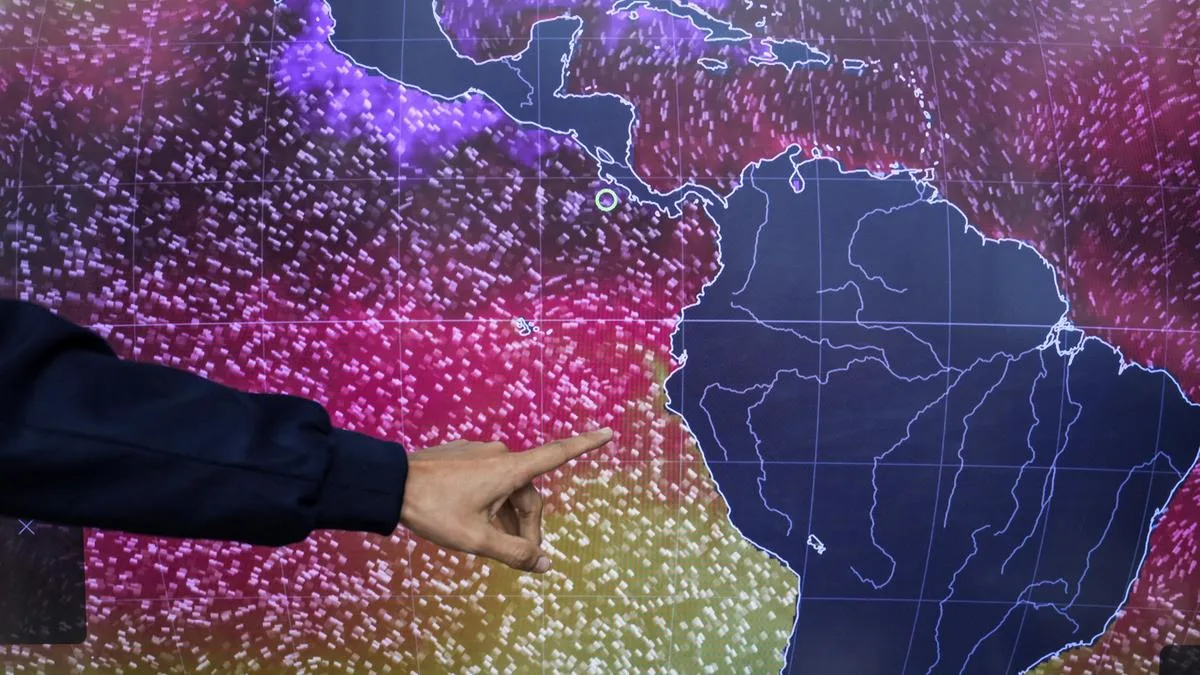
Emmanuel Velasquez, head of forecasting and monitoring at the Panama Institute of Meteorology and Hydrology, shows a National Oceanic and Atmospheric Administration (NOAA) map of sea surface temperatures indicating unusually warm waters along the Peruvian coast as El Nino warms the eastern Pacific and disrupts marine food supplies, in Panama City. File | Photo Credit: Reuters
This year's El Nino weather pattern will be the biggest in over a century and could make 2027 the hottest year globally, Britain's national weather agency said on Friday (August 21, 2026).
An El Nino weather event happens when warming sea surface temperatures in the tropical eastern Pacific trigger worldwide changes in winds, atmospheric pressure and rainfall, as well as higher global temperatures overall.
Adam Scaife, head of long-range forecasting at the weather agency, told the BBC : "We are expecting the biggest El Nino for over a century, peaking at something over three degrees - that is unheard of in modern climate records."
This means Pacific water would heat up more than 3 degrees Celsius above the norm in the coming months.
El Nino occurs when water temperatures rise at least 0.5 degrees Celsius, above the baseline. While it is part of a natural cycle, scientists agree climate change increases its impacts.
A record El Nino would be "adding to the stresses of climate change" following a summer of heatwaves across Europe, the Met Office said in a blog.
Temperatures in the Pacific region are currently running about 2.6 degrees Celsius, above a rolling 30-year average, according to the Climate Brink dashboard based on data from the U.S. National Oceanic and Atmospheric Administration.
The dashboard also aggregates forecasts that put El Nino on course to peak at a 3.9 degrees Celsius, anomaly this November - well above a 3 degrees Celsius anomaly detected in 2015.
"We should be clear that this is an unprecedented event," British scientist Scaife said in a Met Office blog.
If the forecast is accurate, then 2026 "will far exceed our recent experience of El Nino and its worldwide climate influences", said the physicist who specialises in climate modelling.
"I have never seen an El Nino signal this intense in our forecasts," he added, with even a 2C rise considered a "really big event".
El Nino typically results in drier conditions across southeast Asia, Australia, southern Africa, and northern Brazil, and wetter conditions in the Horn of Africa, the southern United States, Peru and Ecuador.
5News aggregated this summary from the outlet’s public feed. The full article, with all the context, is on www.thehindu.com — the content belongs to The Hindu - International.