Durga puja in Kolkata: The family that offers five kinds of fish to the goddess
Account subscription benefits alongside Premium Stories, Editorials, Opinions and more. Unlock these with Subscription
The priest, his back bent with age, steps into the thakur dalan (courtyard ) , where a 237-year-old goddess stands. He lifts a great brass lamp, its flames leaping into the air, and his frail frame begins to sway to the insistent rhythm of the dhaak. Through the incense-thick air, he traces the contours of the mighty goddess with circles of fire, illuminating her face, then letting it recede into shadow.
It was this very countenance, the Bandopadhyay family believes, that appeared to Krishna Chandra Bandyopadhyay in a dream in 1790 in Bajrajogini village in Bikrampur, then part of Dhaka.
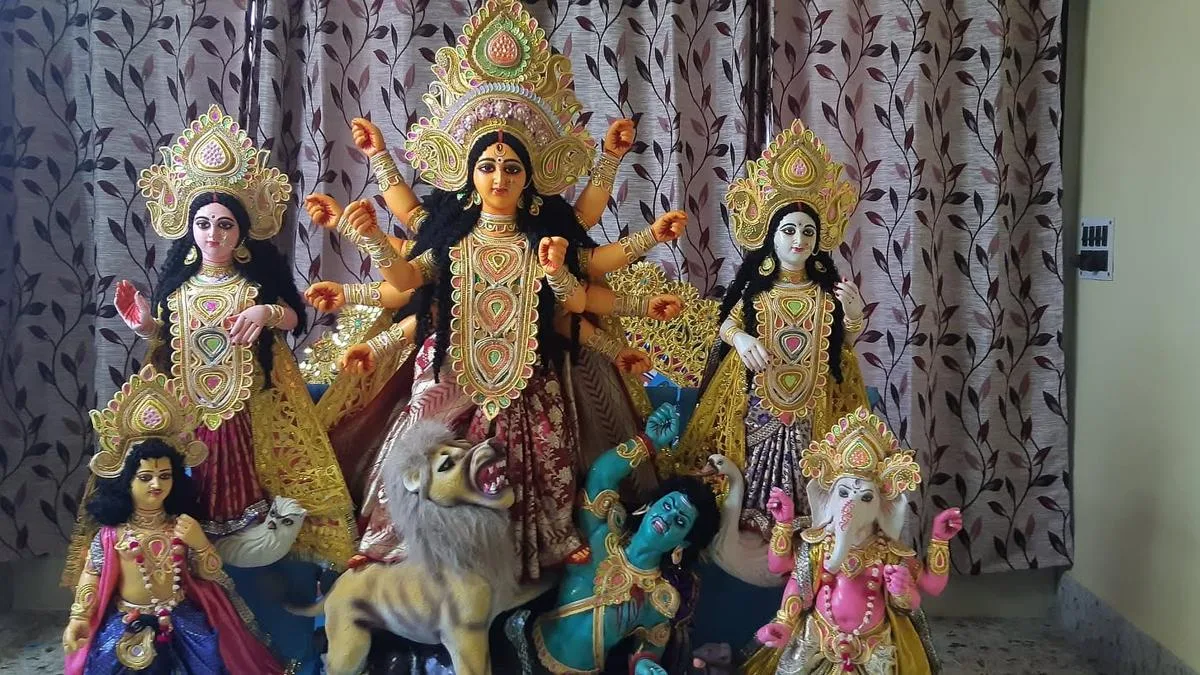
There is something unusual about the way the goddess sits in the Bandyopadhyay family’s Durga puja. Look closely at the idol, and the familiar order of things appears to have been turned on its head. Ganesha, usually placed to the right of Durga, sits on her left, beside Saraswati. On the other side are Kartikeya and Lakshmi. Her form is distinctive. Mahishasura, the demon she vanquishes, has no legs; he emerges from the belly of a decapitated buffalo. The unusual depiction, according to Sombuddha Banerjee, organiser of the puja, is part of the form revealed in Krishna Chandra Bandyopadhyay’s dream.
Mahishasura, the demon Durga vanquishes, has no legs; he emerges from the belly of a decapitated buffalo | Photo Credit: Sombuddha Banerjee
For the past few years, the idol has been sculpted by Basudeb Pal, who begins work after the framework is prepared on the day of Ulto Rath. In earlier times, Kathamo Pujo, the ritual worship of the framework, was also performed on that day. The reversal of the usual order is one of the many details through which memory has survived.
But to look at this goddess is also to glimpse a world that existed before Partition, preserved in the folds of her sari, the designs of her jewellery and the food laid before her.
The goddess is worshipped as Katyayani (sixth form of Durga), dressed in the Atbangla saaj, which translates to traditional clothing meant for everyday wear. A large, three-tiered crown rises above her head, her eyes are plain, without elaborate embellishment; her face retains a certain softness, almost girlish in its delicacy. For the past decade, she has worn a Benaras sari.
It is her jewellery, however, that carries the memory of a more distant home. The mukut , (crown) motor mala , a traditional Indian necklace made of small, round gold or gold-plated beads that closely resemble green peas (matar) strung together and cheek or choker, are made in old Dhakai designs, with pieces created in Bangladesh before the Partition. Their significance lies not merely in their age or ornamentation, but in the world they evoke: a time when Bajrajogini belonged to a landscape unmarked by the border that would eventually divide Bengal.
The goddess is worshipped as Katyayani (sixth form of Durga), dressed in the Atbangla saaj, which translates to traditional clothing meant for everyday wear.
5News aggregated this summary from the outlet’s public feed. The full article, with all the context, is on www.thehindu.com — the content belongs to The Hindu.