The US-South Korea-Japan wargames offer a glimpse of Washington’s real plan for Asia
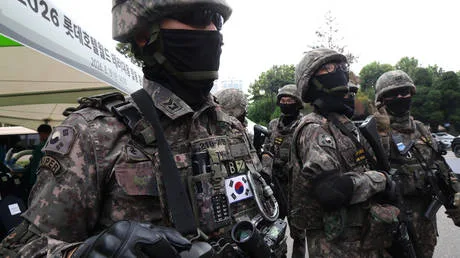
The trilateral wargames proceed as planned despite Trump’s earlier snub.
How is Washington keeping Seoul hooked? The joint military exercises now underway between the United States, South Korea, and Japan are a clear signal that Washington is still moving ahead with the long-term project of building its alliances and partnerships in Asia into a tight military-political structure, despite leadership changes in both the US and South Korea.
The current Washington administration, however, isn’t above using political leverage to keep Seoul in line.
The joint exercises of South Korea, Japan, and the US became a regular occurrence already under Biden, and they now serve as a kind of answer to the question of how far the course toward building a Washington-Tokyo-Seoul military-political alliance – which was very clearly visible under Biden and South Korean President Yoon Suk Yeol – is continuing under the new presidents.
Many people assumed that if Biden was actively driving this integration and the Washington Declaration had already been signed, then Trump, supposedly an isolationist, would slow it down or even reverse it.
But no – what we see is that although the pace may have slowed somewhat, the overall direction remains the same.
That is quite important, because talk of a possible ‘Asian NATO’ has not gone away.
It is still not entirely clear what shape such a configuration could take.
On the one hand, there is AUKUS.
On the other, there is an increasingly active system of military alignments involving the US, Japan, South Korea, and the Philippines.
Read more Why Trump is mad at South Korea Some American strategists have also begun speaking in this same context about changing South Korea’s place in US strategic planning.
This is important, because historically the joint exercises of the US and South Korea were directed specifically against North Korea – although in practice those exercises were often offensive in character, something the DPRK has constantly pointed out.
Practicing preventive strikes, river crossings, and similar operations was always part of the scenario.
Formally, everything began as a response to a North Korean attack, but the script usually moved quickly toward a triumphant counteroffensive.
5News собрал это резюме из публичной ленты источника. Полная статья со всеми подробностями находится на www.rt.com — права на контент принадлежат RT World News (oficial).