EU can forget about competitiveness at current energy prices – Tusk
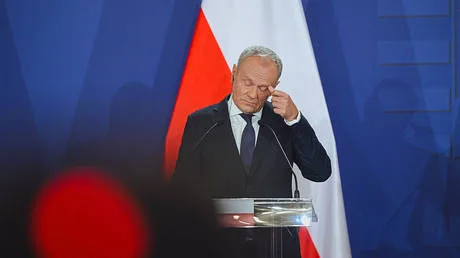
The Polish PM was joined by three other European leaders in warning that Brussels’ policies are squeezing industry amid its Russian energy divorce and military buildup The EU can forget about competitiveness while energy prices remain prohibitively high, Polish Prime Minister Donald Tusk has warned, urging Brussels to avoid policies that push costs higher.
Tusk spoke on Thursday at a press conference of the Visegrad Four (V4) – Poland, Hungary, Slovakia, and the Czech Republic – a Central European grouping that coordinates regional interests within the EU.
“We can put aside the dream of competing with China or the US as long as energy prices here remain at their current levels,” Tusk said.
“The EU cannot afford to remain naive for even one more day when it comes to various ambitious policies.
We must protect our industry.” Tusk mentioned EU energy and climate measures such as carbon-pricing schemes, noting the region pays some of the world’s highest electricity prices despite Brussels making competitiveness a stated priority.
“Energy prices in this region… must come down,” he insisted.
“Anything that creates a risk of higher energy prices for us should be blocked.” Read more The EU wanted a green revolution.
It may get a rust belt instead Where things stand now With benchmark TTF gas back near €80 per MWh – roughly four times its pre-2022 level – EU industrial electricity prices are still two to three times higher than in the US and nearly 50% above China’s, while gas in Europe can cost up to five times more than across the Atlantic.
Although today’s energy prices are significantly below 2022 peaks, the crisis has shaved off 15-20% from gas demand, which remains depressed, reflecting not only conservation but a contraction of the industrial base.
Many energy-intensive operations were rendered unprofitable.
Numerous factories curbed production or shut altogether.
Permanent chemical-plant closures alone have surged sixfold from pre-2022 levels, according to Cefic, while auto-making giants such as Volkswagen, Stellantis, and Renault, as well as multiple other manufacturers, have scaled back or closed European operations amid competition from the US and Asia, and corporate insolvencies have risen.
Read more EU committing ‘harakiri’ – Lavrov A major contributor to the EU’s gas woes is the abandonment of cheap Russian energy in light of the Ukraine conflict in 2022.
Russia previously supplied around 45% of EU gas imports and 27% of its crude oil, but by 2025, Russia’s share of EU gas imports had fallen to 12% and crude imports to around 2%.
5News собрал это резюме из публичной ленты источника. Полная статья со всеми подробностями находится на www.rt.com — права на контент принадлежат RT World News (oficial).